
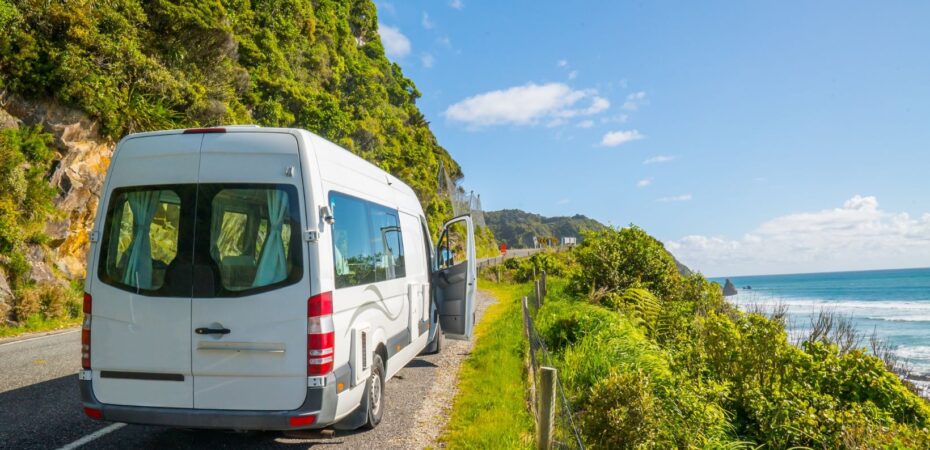
Everyone arrives with the same picture in their head. A van parked side-on to a lake, the door slid open, mountains in the background at seven in the morning.
Then you get to Fiordland. The Department of Conservation, which runs the national parks, is blunt about it: around seven metres of rain a year, spread over roughly 200 rain days. Tekapo and the Mackenzie sit in the mountains’ rain shadow and stay much drier. But a fortnight taking in the West Coast and Fiordland will likely hand you a few wet days. The trip still works. It just needs building differently.
Prep and Rental
Ask about the heater, not the insulation. You can’t check insulation from a listing photo, but you can ask about a diesel heater by name.
Britz publishes the numbers for its own fleet. The heater needs at least 11.5 volts in the house battery, the second battery that powers the living area, and more than a quarter tank of fuel. It burns a litre every four hours at a moderate temperature.
Read those as a chain rather than a promise. The heater doesn’t need the campsite hookup, but the hookup is one of only two ways the house battery refills. The other is driving. Park up for several cold nights, run the heater hard, and the voltage gives out first. The kettle, the toaster and the wall sockets need the hookup outright. The gas hob doesn’t, which is where your coffee comes from.
The other thing to check is the paperwork. Since 7 June 2026, only vans with a green warrant count as self-contained, meaning you can park overnight away from campsites. Blue warrants no longer work for that. A green warrant needs a toilet fixed permanently inside the van, usable while you’re inside it, that empties without lifting out the base. The free-standing portable toilet budget vans used for years no longer qualifies. Confirm the colour in writing, because it decides where you can stop when a storm cuts your day short.
The Route Highlights
Fourteen days covers the classic summer loop out of Christchurch and back. Arthur’s Pass one night, the glaciers two, Wanaka two, Queenstown three, Te Anau two, Aoraki Mount Cook one, Tekapo one. That’s twelve nights placed and two left free.
Keep those two genuinely free rather than parked at the end, so you can spend one wherever a weather front catches you. That means booking the fixed things late: Queenstown and the Milford Sound boat trip, the two you would also unpick to run the loop backwards.
Milford has rules of its own. There’s no fuel and no shops between Te Anau and Milford Sound, so fill up before you leave. The stretch between the Hollyford Road junction and The Chasm is a restricted no-stopping zone, because it sits under avalanche paths. The road closes for avalanche control from time to time. Check the New Zealand Transport Agency’s Journey Planner the night before, while you have signal.
The Reality Check (Rainy Day Backups)
Sooner or later the forecast wins and you lose a day to a campsite. That’s the day to spend money.
A DOC serviced campsite costs NZ$25 an adult for flush toilets, tap water, hot showers, a kitchen bench and rubbish collection. A standard site runs NZ$10 to 20, with toilets, water and room to drive in. A basic site is free, with a simple toilet and water that may need treating. In sunshine that’s fine. On day three of a cold southerly it isn’t.
Go to Milford anyway if the road is open. Rain is why the waterfalls are there, and the cliffs run with temporary ones that vanish in fine weather. The boats sail in the wet, and the photos beat the brochure.
Signal is worth planning around, because it isn’t spread evenly. Spark says its 4G and 5G networks together reach 99 percent of New Zealanders. One NZ says its networks cover 99 percent of the places people work, live and play, and that 5G reaches 69 percent of those. Neither figure measures land area: one counts people, the other places. So the signal is fine at a holiday park outside Queenstown and thins to almost nothing on the road to Milford, where DOC lists one satellite emergency phone at Homer Tunnel and card-phones at Knobs Flat and Milford.
Back at a campsite within reach of a town, the evening fills itself. There’s coffee on the gas, a day of photos to sort, a film you downloaded earlier. With local TV offering little, many travelers turn to their phones. It’s no surprise that the best online casino in New Zealand gets a surge of traffic on nights like this, killing a few hours between the second flat white and the rain finally easing off.
Essential Apps to Download Before You Drive
CamperMate is the campsite-finding app everybody recommends and the one people set up wrong. Download its offline maps before you lose signal, or you get campsite icons on a blurry grey background just when you need a toilet.
MetService, the national forecaster, is worth learning rather than glancing at. Its alerts come in three levels. A yellow Watch means severe weather looks likely enough to need a Warning, while forecasters work out where and how bad. Keep tomorrow flexible. An Orange Warning means the forecast will meet its severe weather criteria, so move to a serviced site. A Red Warning is kept for the most extreme events, and the answer to one is to stop driving.
Add the Journey Planner for road closures, and offline Google Maps too. Do it where you have signal, in Christchurch, Wanaka or Te Anau, not at the campsite. Google Maps limits how big one offline area can be, so the South Island takes three or four overlapping downloads.
Two Weeks, Weather Included
The South Island never promised anyone a clear fortnight. The trips that go well are planned that way. Get a green warrant. Learn how the heater draws on the battery. Leave two nights unbooked. Download everything early. Do those four and a washed-out afternoon stops being the day the trip went wrong. It’s the day you saw Milford with the waterfalls running.
 By Gregory O'Neill
Greg is a modern-day explorer with an insatiable love for travel. His passion for adventure has led him to far-flung corners of the world, where he immerses himself in diverse cultures and experiences. Greg's zest for life is epitomized by a continuous pursuit of new horizons and captivating journeys.


