
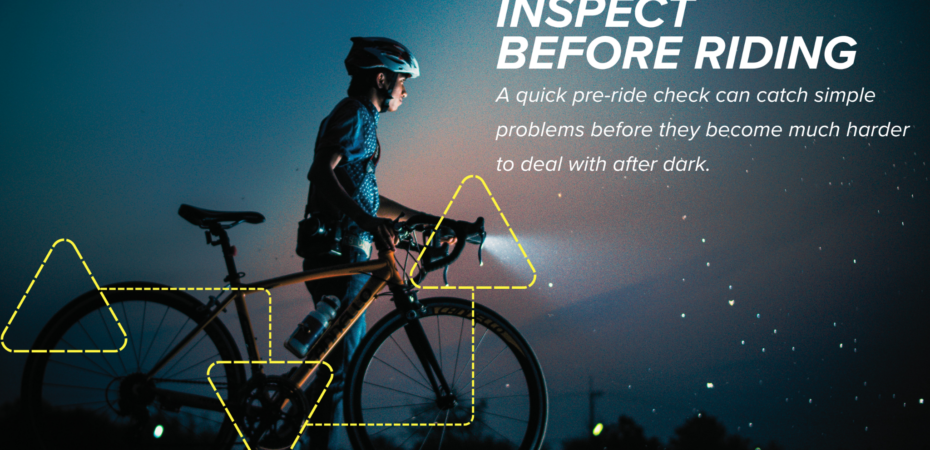
E-bikes have changed what a daily commute can look like. Longer distances become manageable, hills are less intimidating, and riders can often avoid traffic jams altogether. But when the commute happens after sunset, the riding environment changes significantly.
Visibility drops. Drivers have less time to notice cyclists. Potholes and road debris become harder to spot. Intersections can be more difficult to read, and glare from headlights can temporarily obscure what is happening ahead.
For e-bike riders, there is another consideration: speed. An e-bike can cover ground considerably faster than a conventional bicycle, which means a rider may reach an intersection, driveway or road hazard sooner than another road user expects.
A safer night commute therefore isn’t simply about attaching a light and heading home. It requires thinking about visibility, equipment, route choice and riding habits together.
1. Make being seen as important as seeing the road
A powerful front light is useful for identifying potholes, turns and obstacles, but night-riding visibility works in both directions.
Other road users also need to recognize that you are there.
A practical setup starts with a white front light and red rear light, supported by reflective elements on clothing, a backpack, helmet or bike. Reflective details are particularly useful when illuminated by vehicle headlights.
Before leaving, check that lights are actually visible rather than obstructed by a bag, jacket, basket or other accessory.
Light positioning matters too. A front light should illuminate the road without being aimed so high that it creates unnecessary glare for approaching riders and drivers.
2. Treat your helmet as part of your visibility system
A helmet remains one of the most important pieces of equipment for any commute, but night riders can also think about how it contributes to visibility.
Reflective decals or bright details can make a rider easier to distinguish in low light. Some modern helmets also incorporate lighting or other visibility-oriented features directly into their design.
For riders researching equipment, a smart helmet for e-bike commuting can combine conventional protective design with features intended to make everyday urban riding more practical.
Whatever helmet you choose, correct fit remains essential. It should sit level on the head, remain secure when you move and be fastened correctly before every ride.
3. Use both front and rear lighting
A common mistake is concentrating almost entirely on the front of the bike.
Your rear light is just as important because much of the traffic interacting with you will initially approach from behind.
Use dedicated bicycle front and rear lights rather than relying solely on street lighting. Urban lighting can be inconsistent, and a road that appears well illuminated for several blocks can suddenly become significantly darker.
Rechargeable lights should also become part of your commuting routine. Check battery levels before leaving rather than discovering halfway home that a light is fading.
Active lighting improves motorists’ detection and recognition of cyclists. It also notes that most US states require active lights and reflectors on bicycles ridden at night, although the exact rules vary.
A compact lighting system can be particularly useful for commuters who do not want permanently mounted accessories.
UNIT 1’s Smart Light can switch between white front and red rear operation depending on how it is mounted. Riders wanting a complete setup can use two as bicycle front and rear lights, while magnetic mounting allows the lights to be removed when the bike is parked. The lights recharge via USB-C and can also be attached to compatible helmet, saddle, clip and backpack mounts.
4. Choose the safest route, not necessarily the shortest one
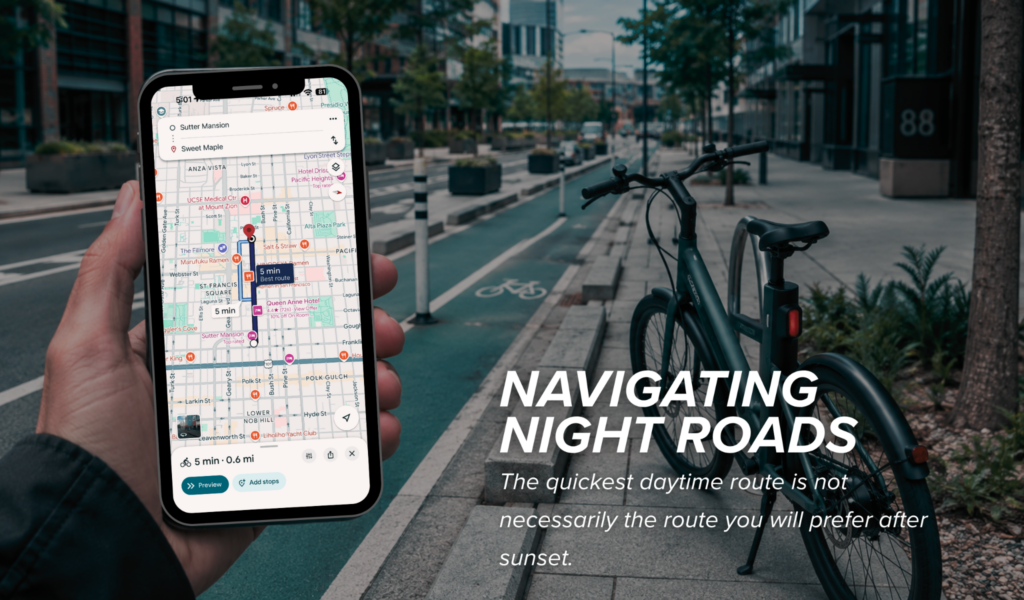
The route you take during daylight may not be the best route after dark.
A quieter side street can become poorly illuminated at night, while a slightly longer road may offer better street lighting, dedicated cycling infrastructure and more predictable intersections.
When planning a regular night commute, consider:
- Street lighting and visibility
- Protected or clearly marked cycling lanes
- Road surface quality
- Number of complicated intersections
- Traffic speed
- Construction zones
- Isolated stretches of road
Adding five or ten minutes to a journey can be worthwhile if the alternative route provides significantly better visibility and separation from fast-moving vehicles.
5. Reduce speed when visibility becomes uncertain
Electric assistance makes it easy to maintain speed, including on sections where slowing down would be safer.
At night, your speed should reflect how far ahead you can clearly see.
If your light illuminates only a limited section of road, riding faster than your visible stopping distance creates unnecessary risk. A pothole, pedestrian, animal or piece of debris can appear suddenly.
This becomes especially important when approaching intersections, parked cars and driveways.
A vehicle pulling from a driveway may not expect a bicycle to arrive as quickly as an e-bike can.
6. Assume drivers haven’t seen you
Being visible does not necessarily mean you have been noticed.
At intersections, avoid relying entirely on eye contact or assuming that a driver will yield because you have the right of way. Watch the vehicle’s movement and be prepared for unexpected turns.
Parked cars deserve similar caution. Leave enough space to react if a door opens suddenly or a vehicle begins pulling into traffic.
At night, defensive riding means giving yourself additional time and space whenever another road user’s intentions are uncertain.
7. Keep your movements predictable
Sudden movements are harder for drivers and other cyclists to interpret after dark.
Signal turns early, maintain a consistent road position and avoid weaving unnecessarily between parked vehicles.
If you need to change lanes, look behind you well before moving and signal clearly.
Predictability becomes particularly important for faster e-bike riders because other road users may initially judge your speed as though you were riding a conventional bicycle.
8. Don’t let headphones isolate you from traffic
Night riding already reduces one of your most important sources of information: vision.
Avoid removing another by blocking surrounding sound.
Traffic noise can alert you to a vehicle approaching from behind, a motorcycle accelerating nearby or another cyclist preparing to pass.
If you use navigation or audio during a commute, keep enough environmental awareness to hear what is happening around you.
9. Prepare for glare, rain and changing conditions
Night commuting becomes more challenging when poor weather is added to the equation.
Rain can reduce tire grip and visibility while increasing reflections from headlights, streetlights and wet road surfaces. Braking distances may increase as well.
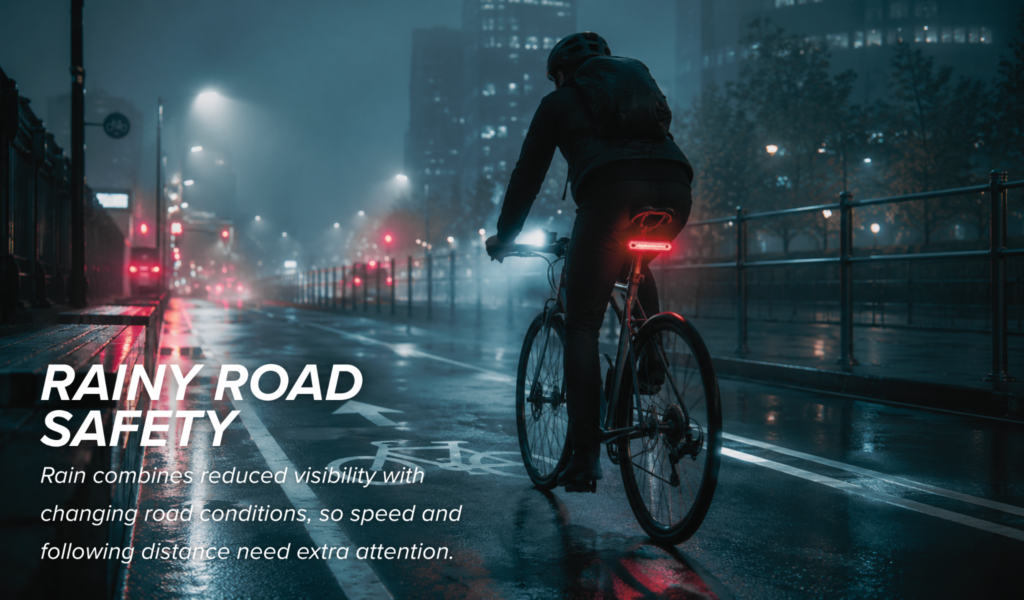
Slow down and allow additional space.
Clear eyewear can help protect your eyes from wind, insects and road debris without reducing visibility the way dark lenses can after sunset.
Your clothing should also match the conditions. Staying warm and dry isn’t merely about comfort; discomfort and cold can affect concentration during a longer commute.
10. Do a 60-second check before every night ride
Before riding away, check the basics:
- Front white light working and charged
- Rear red light visible and unobstructed
- E-bike battery has enough range
- Brakes and tires feel normal
- Helmet fitted and securely fastened
- Phone charged with navigation ready
- Reflective or high-visibility details visible
- Bags and loose clothing secured
- Weather checked
- Backup route considered
Night commuting does not need to feel complicated. Most of the useful habits are small ones: charge your equipment, check the bike, choose the route carefully and make your presence and intentions as easy as possible for other road users to understand.
Once those habits become routine, an e-bike remains what makes it so useful in the first place: a convenient way to move around without turning every journey into a major production.
Night riding is ultimately about giving yourself more margin
Safe night commuting isn’t achieved through one accessory.
Good lighting helps drivers notice you. A properly fitted helmet provides essential protection. A carefully selected route reduces exposure to unnecessary hazards. Lower speeds give you more time to respond, while predictable riding makes it easier for everyone else to understand what you are doing.
The best night-commute setup is therefore the one that creates additional margin at every stage of the journey.
You want more distance to identify hazards, more time to brake, more opportunities for drivers to see you and fewer situations where you have to depend on someone else reacting perfectly.
For e-bike riders who regularly travel after sunset, those small decisions can turn night riding from something uncertain into a much more controlled and confident part of the daily commute.
 By
By 


