
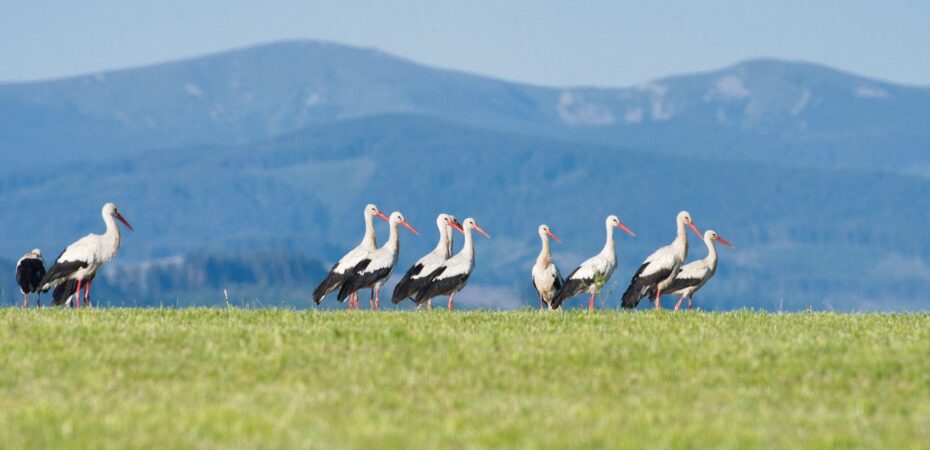
Central and Eastern Europe is a fantastic birding location.
These great regions are packed with large areas of marshland, river valleys, steppe, and intertidal habitats, all covered in birds. Then there are all the migrating birds moving through. Then there are thousands of species of birds to see. There are lots to see all year round. Thousands of cranes. Thousands of warblers in the reed beds. Passing wetland filled with tens of thousands of pelicans. So pick up your binoculars and cameras and get ready to be inspired.
In this region, there are 4 places to watch wildlife and the greatest range of habitats that are impossible to miss. Those are the Hortobagy National Park in Hungary, the Biebrza Marshes in Poland, the Danube Delta in Romania, and Matsalu National Park in Estonia.
1. Hortobágy National Park, Hungary
The vast plains of Hortobágy National Park offer a different birding experience compared to most other European sites. This is the Great Plain of Hungary, which has an intriguing mix of alkali grasslands, marshes, fishponds and wetlands under big skies.
It is a vital spot for migrating birds, with the UNESCO Man and the Biosphere Programme designating Hortobágy as an environment hotspot for the Central European bird migration flyway, including steppe and grasslands in addition to marshlands and fishponds.
The cranes, however, steal the show come autumn. There are thousands on the wetlands before they head on the next stage of their journey, and they make for an impressive sight at sunset. Birdwatchers are likely to see great bustards, imperial eagles, saker falcons, rollers and a lot of waterbirds.
There is also an added dimension to the park: the rich cultural links between the wildlife and the traditional pastoral way of life. UNESCO recognizes Hortobágy as a cultural landscape shaped by centuries of grazing and traditional land use. For visitors who want to explore the region with a specialist focus, birdwatching tours in Hungary can offer a structured way to discover its wetlands, migration routes and characteristic species.
2. Biebrza Marshes, Poland
The Biebrza Marshes in Poland couldn’t be more different. It is the largest complex of its kind in central Europe and is centred around the tortuous river of the same name.
There are a huge number of birds (more than 280 species have been registered), with aquatic warbler, great snipe, black grouse and raptors likely in the national park.
The best time of year is in spring when the valley bottom can be inundated by water, creating temporary homes for waders and waterfowl. If it floods over a large area, you can get vast numbers of birds in a small place.
The official Biebrza National Park claims that the marshes are one of the most important wetland bird refuges in Poland and Europe.
For the birder, Biebrza is a place to be patient. You might see a raptor while waiting quietly on a raised path in a bog, or observe a bittern shuffling through the rushes when you simply sit and watch.
3. Danube Delta, Romania
The Danube Delta is one of the great wetland landscapes in Europe. Here, the Danube River divides into a maze of channels and waterways, edged by lagoons, reed beds, marshes and meadows.
This complex of habitats creates one of the continent’s greatest hotspots for birdlife. UNESCO records more than 300 bird species, along with 45 freshwater fish species.
A particularly notable attraction is the Pelican family; there are both white and Dalmatian pelicans here, along with cormorants, herons, ibises, spoonbills, eagles and any number of other water birds.
A great thing about birding here is the chance to hire boats and travel around by water. Small rivers and channels take you into some of the quieter corners of the delta, reed beds and shallow pools where you may see special birds that are seldom found in more open locations.
The spring and autumn migrations are the peak times, but in the summer you can see birds breeding, and watch the comings and goings from the nesting colonies.
4. Matsalu National Park, Estonia
Encompassing shallow coastal waters, reed beds, flood meadows, islands and the large Matsalu Bay, this national park on Estonia’s western coast is one of Europe’s most important places for migratory birds, with 270 species having been recorded in the park and surrounding areas.
Spring and autumn are the best times to visit this park, as thousands of migrating birds use the area of wetland and coastal meadows as a stopover to feed and gain strength. The Estonian tourist board says that in the months of April to mid-May and September to the end of October, the country is a place filled with birds that come and visit.
One of the most symbolic species in autumn is certainly the crane, but also geese, ducks, wading birds and passerines will be the ones to bring life to the area. Also, the park has various viewing towers in key locations to enable bird watchers to watch the wetland wildlife without frightening the birds.
Matsalu is a destination where the landscapes are inseparable from the experience. Coastal meadows, reeds and waters that are sheltered from the wind all display different faces depending on the movements of migratory birds: a particularly impressive sight is the massive flocks all ascending from the wetlands at once.
Four destinations, four different birding experiences
These four sites illustrate the variety of Central and Eastern Europe. Hortobágy, with its spectacle of roosting cranes on an open Hungarian steppe. Biebrza, where the visitor is immersed in Poland’s vast, wildlife-rich riverine marshes. The Danube Delta, where a maze of waterways and reeds creates one of the continent’s most arresting landscapes. And Matsalu, combining coastal habitats with one of northern Europe’s most impressive migration spectacles.
The seasons make a big difference. Spring can see vast numbers of migrants and breeding activity, while autumn produces spectacular congregations before the birds head south. For anyone seeking ideas where wildlife, landscapes and slower travel are present, there’s ample justification for looking beyond the familiar short-haul city breaks to be found in Europe.
 By Gregory O'Neill
Greg is a modern-day explorer with an insatiable love for travel. His passion for adventure has led him to far-flung corners of the world, where he immerses himself in diverse cultures and experiences. Greg's zest for life is epitomized by a continuous pursuit of new horizons and captivating journeys.