
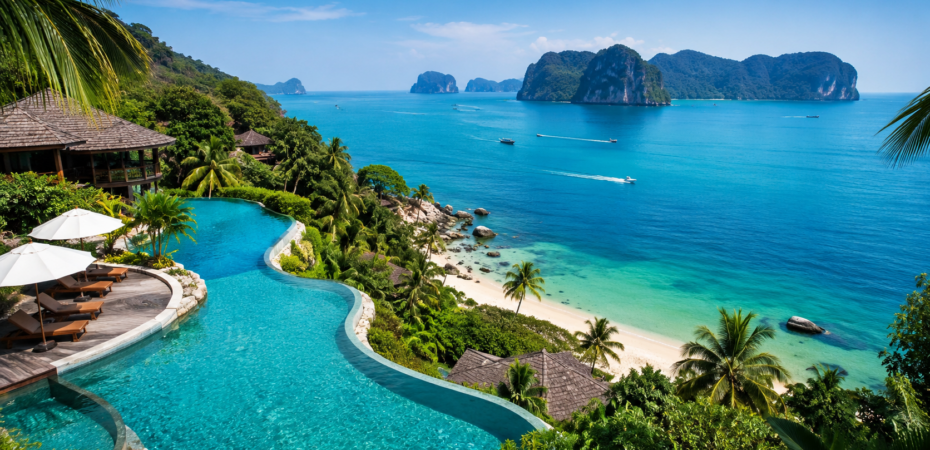
There’s a running debate among Thailand travellers that never quite gets resolved. One side says the only way to do Thailand is independently – hostels, street food, ferry hopping between islands with nothing booked beyond tomorrow. The other side quietly books an all-inclusive resort in Phuket and has an excellent time without telling anyone. Both are valid. But only one of them gets talked about online, which is why so many first-time visitors don’t realise that Thailand travel packages with everything bundled together are a genuine option – and sometimes the smarter one.
Here’s what the all-inclusive side of Thailand actually looks like, and when it makes sense to go that route.
Why All Inclusive Works in Thailand
Thailand’s reputation as a budget backpacker destination is well earned but slightly outdated. Prices have risen. Popular islands get busy. And the logistics of island-hopping – ferries, domestic flights, transfers, accommodation at each stop – add up faster than most people expect, especially if you’re travelling as a couple or family rather than solo with a backpack.
This is where all inclusive vacations start to make real sense. A resort in Phuket, Koh Samui, or Krabi that bundles flights, transfers, accommodation, meals, and activities into one price removes the daily mental arithmetic of “how much have we spent today.” For families especially, that predictability is worth paying a premium for – no arguments about where to eat, no surprise costs, no figuring out whether the taxi driver is quoting a fair rate.
Where the All Inclusive Resorts Actually Are
Not every Thai island does the all-inclusive model well. Here’s where it works best.
- Phuket has the widest range. The west coast – Kata, Karon, Kamala – has resorts at every price point, most with pool access, beach proximity, and enough on-site restaurants that you don’t need to leave unless you want to. It’s also the easiest island to reach from North America, with direct connections through major Gulf hubs.
- Koh Samui leans slightly more upscale. Chaweng and Lamai have the big resort properties, while the quieter north coast around Bophut has boutique options that still operate on an all-inclusive or full-board basis. The airport is privately operated (Bangkok Airways), which keeps flight prices higher but means fewer crowds and a more relaxed arrival.
- Krabi and Khao Lak on the mainland are worth considering if you prefer a quieter setting. Both have resort properties set against jungle-backed beaches with significantly fewer tourists than Phuket – and often at lower rates for comparable quality.
Specialist providers like Travelodeal list Thailand packages with flights from Canadian airports, resort transfers, and all-inclusive board bundled together, which simplifies comparison shopping and usually works out cheaper than piecing the same trip together independently.
When All Inclusive Doesn’t Make Sense
Being honest about this: if your goal is to explore Thailand deeply – temples in Chiang Mai, night markets in Bangkok, island-hopping across the Gulf – then locking yourself into one resort for a week is going to feel limiting. The all-inclusive model works best when the destination is the resort itself, not the country around it. For beach-focused trips where the priority is relaxation over exploration, it’s ideal. For cultural immersion, it’s the wrong tool.
The middle ground that works for a lot of travellers: a few days in Bangkok or Chiang Mai booked independently, followed by a week at an all-inclusive resort on the coast. You get both versions of Thailand without either one feeling rushed or compromised.
Best Time to Book
November through March is peak season – best weather, busiest resorts, highest prices. Shoulder months (April, May, October) bring lower rates and fewer crowds, with weather that’s still mostly good despite being technically “wet season.” Rain in Thailand usually means a short afternoon downpour, not a week of grey skies.
For Canadian travellers, booking four to six weeks out tends to hit the sweet spot between availability and pricing. Too far ahead and you’re paying full rate. Too close and the best rooms are taken. Somewhere in that window is usually where the deals sit.
 By Gregory O'Neill
Greg is a modern-day explorer with an insatiable love for travel. His passion for adventure has led him to far-flung corners of the world, where he immerses himself in diverse cultures and experiences. Greg's zest for life is epitomized by a continuous pursuit of new horizons and captivating journeys.


