
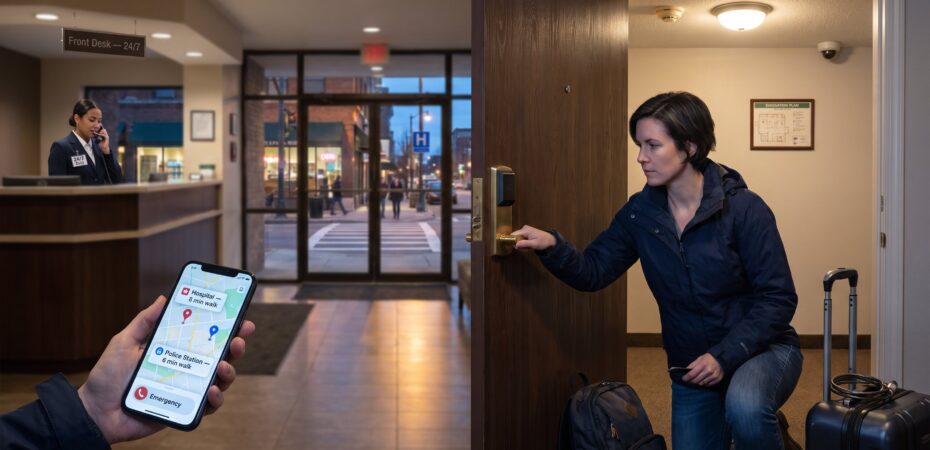
How to find a safer place to stay in an unfamiliar city starts with focused research and simple checks. Travelers who use a short, repeatable method cut exposure to theft, harassment, and poor emergency access. This guide gives a compact checklist before booking, reliable research sources, neighborhood selection rules, and quick on‑the‑ground inspections after arrival. Each section opens with the key action, followed by precise examples and warnings drawn from recent travel reporting and industry best practice.
Key Takeaways
- Confirm 24/7 staffed reception, controlled access, and safety devices like smoke detectors before booking to ensure a safer place to stay.
- Use official advisories, local crime maps, and verified travel reviews to research neighborhood safety and avoid high-risk areas.
- Choose mixed-use, well-lit neighborhoods near police stations, hospitals, and transport hubs for better security and emergency access.
- After arrival, inspect room locks, emergency exits, and test staff responsiveness to assess on-the-ground safety.
- Use licensed transport options and secure valuables in in-room safes or locked luggage to reduce theft risk.
- Adopt this repeatable safety checklist on every trip to consistently lower exposure to theft, harassment, and emergency delays.
Quick Safety Checklist To Use Before You Book
Key action: confirm people, locks, cameras, and detectors before payment.
Start by verifying there is a 24/7 staffed reception or a verified host contact reachable by phone. If staff or a host cannot be reached within minutes, treat the listing as higher risk. Look for controlled access: key‑card or coded entry to the building and guest floors. In hotels, prioritize properties that list elevator access by key card and have separate staff entrances.
Check security hardware in the listing photos and descriptions: CCTV in entrances and corridors, deadbolts, secure window/balcony locks, and clearly marked emergency exits. Prefer rooms on floors 3–6: floor 1 or ground level increases risk of break‑ins while very high floors slow escape in an emergency.
Confirm life‑safety equipment: smoke and CO detectors, visible fire extinguishers, and posted evacuation maps. If the property doesn’t mention these, message the host or front desk and keep their reply as proof.
Read recent reviews from the last 6–12 months and filter for “safety,” “break‑in,” “lighting,” and “harassment.” Pay attention to recurring complaints about lighting, taxi scams near the address, or staff responsiveness. One guest’s note about “no night staff” means the place should be downgraded in risk assessments.
Practical warning: never book a private listing that refuses to supply an exact street address before payment. Without an address you can’t check crime maps or emergency proximity.
High-Value Research Sources And What To Look For
Key action: triangulate official advisories, local data, and recent eyewitness reports.
Start with government travel advisories for the destination country or city, they note protest zones, terrorism alerts, and civil unrest. Next, use local crime maps or municipal police statistics to check rates of theft, assault, and burglary near the planned address. For neighborhood context, Lonely Planet’s neighborhood listings help identify which districts are residential, nightlife, or high‑traffic commercial areas: that helps predict foot traffic and lighting patterns neighborhood directory.
Consult organizational guidance from universities or corporate travel teams for hotel security standards and room‑choice advice. These sources often recommend specific floors, room locations, and hotel amenity minimums.
Use reputable travel platforms and filter reviews for security terms. Platforms that publish trust and safety policies help interpret review reliability: when a platform enforces identity checks, complaints about safety tend to be better vetted. For platform policy context, travelers may reference TripAdvisor’s safety overview, which explains community standards and reporting tools Trust & Safety.
Balance news coverage with micro‑reports: local news often reports recurring street‑level problems (e.g., repeated muggings on a named block). Cross‑check any worrying pattern with at least two independent sources before altering plans.
Link to practical planning: After this research, consult the site’s hotel guide for booking tactics and standards that align with these checks using a short primer on choosing stays hotel guide.
How To Choose Safer Neighborhoods And Understand Local Risks
Key action: pick mixed‑use, well‑lit areas near essential services and transit.
Prefer neighborhoods that mix residential and daytime commerce. These areas usually have consistent foot traffic after dark, more street lighting, and active shopfronts that discourage opportunistic crime. Avoid single‑use zones: pure industrial blocks or streets dense with late‑night bars show spikes in disorder on weekends.
Check proximity to police stations, hospitals, and 24‑hour transport hubs. A hotel within a 10‑minute walk to a hospital or police post shortens emergency response times. Measure walking times on a map rather than assume short distances are safe at night.
Adjust choices for trip purpose. If someone plans late meetings, prioritize safe transit corridors and hotels near trusted ride services. For families, choose lower‑risk neighborhoods listed in family guides: TravelTweaks has region‑specific recommendations, including family and pet‑friendly picks for destinations like Salt Lake City family picks.
Use concrete street‑level signals: good crosswalks, consistent sidewalk coverage, visible street signage, and CCTV poles. One block with eight functioning streetlights and active corner shops is typically safer than a nearby block with two lights and shuttered storefronts.
Practical example: in Singapore, neighborhoods with mixed retail and residential blocks show lower street theft rates: TravelTweaks lists safe areas to relax that correspond to those patterns stay singapore.
Warning: avoid neighborhoods flagged for recurring protests or political gatherings on the dates of travel. Local news calendars and government advisories will list scheduled demonstrations.
On-The-Ground Tactics To Assess Safety After You Arrive
Key action: inspect exits, locks, detectors, and the block before settling in.
Immediately map the nearest exits, the closest hospital, the local police station, and a 24‑hour pharmacy. Put those locations into a phone contact labeled “Emergency.” Test the front desk or host phone number with a brief call: if it rings through quickly, note the response time.
Do a room inspection: test deadbolts, check windows and balcony locks, ensure there is an evacuation map on the door or hallway, and confirm smoke/CO detectors emit a quick beep during their self‑test. If any item fails, request another room or ask for a maintenance check. Honest mistakes happen: one traveler reported a missing deadbolt and the desk fixed it within 20 minutes, that responsiveness is a safety signal.
Walk the block by day and again near dusk: note lighting, groups loitering, open drinking, and aggressive panhandling. A single aggressive encounter doesn’t make a neighborhood unsafe, but repeated signs of disorder across several blocks are red flags.
Use trusted transport options. Favor licensed taxis with visible credentials, high‑rated ride‑hailing drivers, or city‑run shuttles. Avoid rides from unmarked vehicles offering lower fares. When walking at night, stick to main roads rather than dim shortcuts and share live location with a trusted contact.
Secure valuables: place passports and spare cash in the in‑room safe and use a small portable lock for luggage. If the room lacks a safe, split documents: one set in a locked suitcase, another scanned copy in cloud storage. In one concrete case, a traveler’s phone was stolen from an unlocked bag: the insurer required proof that the phone had been secured, a locked suitcase and safe made claims simpler.
Local tip: ask the front desk which exits the staff use after midnight. If staff avoid a nearby alley, take that cue seriously.
Conclusion
Systematic pre‑booking checks plus on‑arrival inspections cut exposure to most common risks. Travelers who verify staffing, controlled access, cameras, and detectors before booking and then confirm locks, exits, and neighborhood safety after arrival lower their chance of theft or delayed emergency response. Start small: use the checklist in the first section on every trip and consult targeted TravelTweaks resources when comparing locations and booking choices.
 By Amey Myers


