
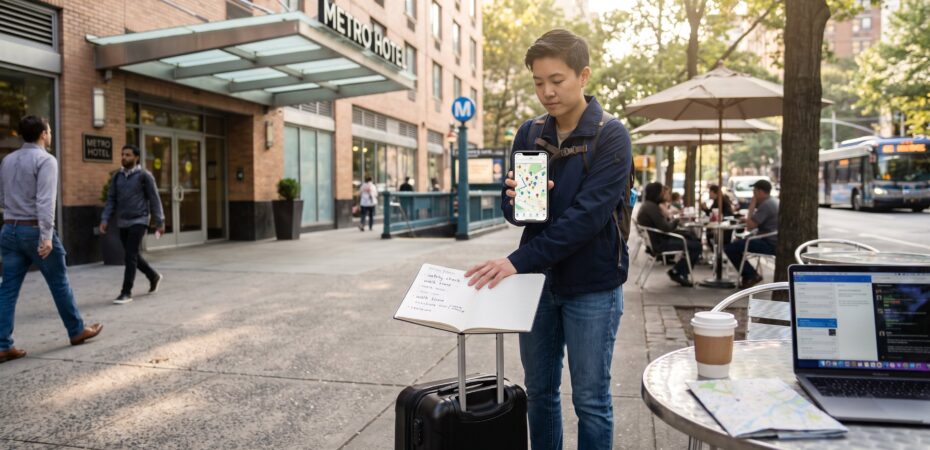
How to Choose the Best Hotel Location for Your Trip starts with a single fact: location dictates time, cost, safety and the rhythm of each day. Travelers who prioritize location cut daily transit, avoid noisy nights, and often save more than the room rate they booked. This guide shows clear steps to weigh budget, safety, convenience and the local experience. It uses concrete checks, maps, reviews, crime data, and real tradeoffs so readers can pick a spot that makes their trip smoother, not harder.
Key Takeaways
- Choosing the best hotel location can significantly reduce daily transit time and travel costs, enhancing trip enjoyment.
- Evaluate hotel location safety by checking neighborhood crime maps, local advisories, and recent guest reviews mentioning security.
- Consider total daily costs, including transport and meals, not just the hotel room rate, to find the true expense of your stay.
- Use maps, Street View, and at least 20 recent reviews to assess convenience, noise levels, and actual surroundings before booking.
- Prioritize your main travel goal—budget, safety, convenience, or local experience—and select the hotel location accordingly to minimize tradeoff regrets.
- Test key routes and transport options at typical travel times to ensure accessibility and avoid unexpected delays or extra expenses.
Why Hotel Location Makes Or Breaks Your Trip
Location dictates a trip’s tempo. Choose a hotel two stops from the center and a traveler can spend 40–90 extra minutes a day on transit: pick a hotel next to a noisy late‑night district and sleep quality drops sharply. The core point: the hotel’s position affects access and time, safety, total cost, and comfort.
Access and time, A hotel within an 800 m walk of a main metro or tram saves both time and taxi money. For example, a 25‑minute roundtrip commute to attractions multiplies into hours over multiple days. Time saved is often the best return on a slightly higher room rate.
Safety, Neighborhood lighting, foot traffic after dark, and recent crime patterns matter. Travelers who check local crime maps avoid pockets with frequent incidents. For reliable safety guidance, travel writers recommend checking neighborhood reports and local advisories: one practical resource on hotel safety summarizes steps to evaluate risks.
Total cost, Cheap rooms far from sites can add taxis, parking, and extra meals. A traveler who paid $40 less per night but spent $15 per day on taxis lost the savings by day three. Think of room price as one input in a daily cost equation.
Comfort and noise, Construction, nightlife, and street traffic reduce rest. Reviews noting “thin walls,” “construction,” or “music till 3 a.m.” are red flags. A well‑chosen location reduces stress and yields more usable time during the trip.
Practical warning: never judge location by photos alone. Use maps and street imagery to confirm actual surroundings before booking.
Decide Your Priorities: Budget, Safety, Convenience And Experience
Start by stating the single most important goal for the stay. That priority drives acceptable tradeoffs.
Budget first, If the principal constraint is cost, add expected daily transport, parking, and meal costs to the nightly rate. A clear example: a traveler on a $90/night budget found that staying downtown for $120/night cut taxi spending from $18/day to $4/day, saving $98 over a five‑night trip. Use a simple spreadsheet: nightly rate + daily transport + parking + average meal cost = true nightly expense.
Safety first, If safety tops the list, require these checks: recent reviews that explicitly mention “safe” or “felt secure,” neighborhood crime maps, and visible lighting on Street View. Travelers concerned about safety should narrow searches to districts with steady foot traffic after 9 p.m. and easily reachable transport hubs. For safety tips from travel experts, a practical external guide outlines specific hotel choices and checks.
Convenience first, If minimizing transit time matters, measure walking distances: keep key points within an 800 m walk and confirm public transport runs at the times you’ll travel. Business travelers who must reach a conference hall at 8 a.m. should test routes for morning peak frequency and travel time. Readers can pair this with the finding guide for a wider view.
Experience first, For a local vibe, choose neighborhoods with neighborhood markets, cafes, and pedestrian streets. For nightlife, pick areas known for evening activity but accept potential noise. The tradeoff here is intentional: choosing atmosphere often means trading quiet and lower cost.
A cautionary note: mixing priorities without weighting them causes regret. Assign one primary and one secondary priority, then filter hotels accordingly.
Related reading on balancing hotel choices can help refine priorities and booking tactics: smart hotel strategies.
Practical Tools And Steps To Evaluate A Specific Location
Answer first: use maps, Street View, reviews, safety overlays and route tests together, not individually.
Step 1, Map the walk and transit times. Open a map and pin the hotel, airport/train station, and two main attractions. Measure walking distances and transit times at the hours you’ll travel. If a late arrival requires a 45‑minute night bus, weigh that against a small fare premium for a closer hotel.
Step 2, Street View the final walk. Look for sidewalks, crossings, lighting, and the last 200 meters between transit stop and the hotel entrance. Travelers who avoid heavy luggage should prioritize a visible taxi rank or elevator access at the station.
Step 3, Scan at least 20 recent reviews, filtering for keywords: “far from,” “unsafe,” “noisy,” “construction,” “late check‑in.” Reviews provide repeated patterns: one mention of a single noisy night is different from many such reports across months. For structured review reading, a checklist approach reduces bias and speeds decisions: check arrival, noise, safety, and transport comments.
Step 4, Use safety overlays and local data. Crime‑map tools show concentrated incident areas: avoid hotels that sit inside those hot spots. Some hotel tools combine safety indices with mapping, use them to confirm findings from reviews.
Step 5, Test the key routes at realistic times. Simulate arriving on the common arrival hour and a late‑night return. Confirm public transport frequency and last departures. If public transit stops early, factor taxi availability and cost into the decision.
Step 6, Cross‑check price and policies. Compare total nightly cost across booking sites and read cancellation rules. For efficient comparison tactics and fee checks, consult this piece on price comparison and cancellation pointers.
Practical links to use while evaluating: a focused checklist for reading reviews helps extract safety and noise signals, and a guide to comparing booking sites speeds honest price checks. Those resources reduce mistakes when a tempting photo hides location problems: review checklist and compare prices.
Honest lesson: the writer once booked a low‑cost room near a transit hub and overlooked a nightly festival: the resulting sleepless nights taught a simple rule, always scan the hotel’s event calendar for recurring disturbances.
Conclusion: Pick A Location That Matches Your Goals And Simplifies Travel
Pick the location that serves the trip’s top goal rather than the lowest room rate. A well‑placed hotel reduces daily transit, cuts hidden expenses, and improves safety and rest. Travelers who match neighborhood vibe to their plans save time and headaches.
A practical next step is to combine the checks above into one decision: list priorities, run map and Street View checks, read 20+ reviews, verify safety data, and test routes. For a complete primer on choosing, comparing and booking the right stay, consult the site’s comprehensive hotel guide within the TravelTweaks network. Safe choices simplify travel and increase enjoyment, choose location deliberately.
 By Amey Myers


