
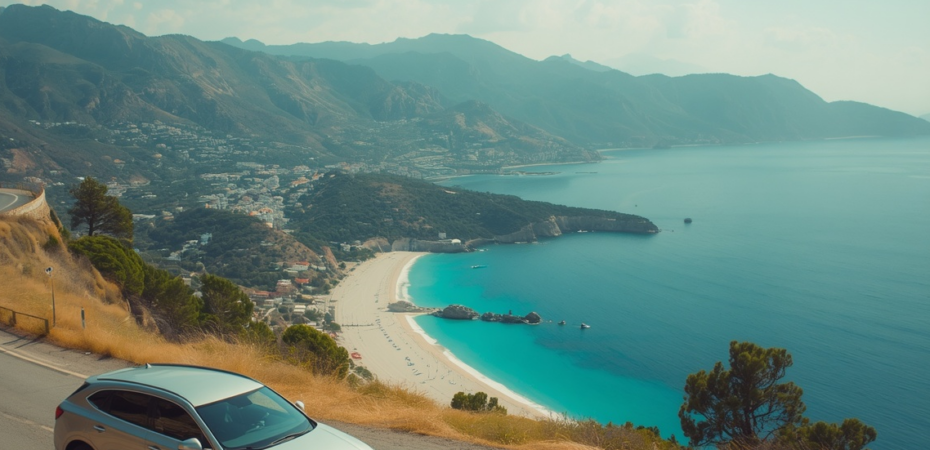
Standing on the white pebble beach in Gjipe Canyon, with sheer limestone walls rising on either side and no one else in sight, it becomes apparent that the crowd and the terrain haven’t quite found each other yet.
Most visitors stick to a corridor. Tirana, maybe Berat, then south to Ksamil for the turquoise water and the social media coordinates. That corridor is genuinely good. It just isn’t the whole picture. Not even close.
Why Does Albania Keep Surprising Even Experienced Travelers?
Because its geography is unusual. Most countries choose between coast and mountains. Albania appears not to have received that memo. Within a few hours of driving, the Albanian Riviera drops from 1,000-metre limestone ridges directly into the Ionian Sea. The Accursed Mountains in the north look like something from a Werner Herzog film. The interior valleys hold Ottoman towns that historians would queue to see if they were located somewhere more familiar.
According to data tracked by World Tourism Organization (UN Tourism), Southern and Mediterranean Europe recorded its highest international arrival figures on record in 2025, yet Albania’s rural and coastal interior regions remain among the least-commercialised Mediterranean destinations anywhere. That gap between visitor numbers and genuine exploration is part of what makes 2026 still a good year to go properly.
Getting between the distinct zones – coast, mountain, valley, interior – on public transport is possible in theory and genuinely frustrating in practice. Bus schedules in the north stop making geographic sense fairly quickly. Travelers who explore Albania with proper flexibility tend to do so by car. Booking car rental Albania through local operators – rather than international chains – consistently results in lower daily rates (typically 30-40% less for the same vehicle class) and pick-up points that actually correspond to where travelers start their trip, including Tirana airport, Shkodër, and Vlorë. Industry observers note that local providers also bring on-the-ground route knowledge that no app navigation quite replicates on mountain roads.
The Riviera Below the Llogara Pass
The Llogara Pass sits at around 1,040 metres and separates the interior from the Ionian coastline below. The descent, 22 kilometres of switchbacks through pine forest, is the kind of drive that makes people question why they ever book package tours.
Below the pass, the Albanian Riviera begins in earnest. The stretch from Dhermi to Himara is where the rewards concentrate – not because those places are undiscovered (they aren’t, exactly) but because the coastline between them still holds corners that reward curiosity.
Dhermi splits into two distinct zones: an old stone-built village on the hillside above and a beachfront strip below. The beach at Drymades, a short distance from the main stretch, remains one of the more photogenic spots on the entire coast – white pebbles, clear water, backed by mountains.
Gjipe Canyon sits between Dhermi and Jale and is the kind of place that needs no marketing. Towering limestone walls channel down to a hidden pebble beach at the sea’s edge. Getting there means either a 40-minute walk through the canyon itself or arriving by boat from Himara. Either approach works. The canyon from the water, looking up at those walls, registers as genuinely spectacular in a way that photographs don’t quite capture.
Himara operates as the practical base for the central Riviera. It’s calm in a way that Ksamil isn’t in summer. From here, boat tours run to Porto Palermo Bay – a deeply sheltered inlet with Ali Pasha’s triangular castle and a Cold War-era submarine tunnel – and to the Blue Cave (Haxhi Ali Cave) on the western flank of the Karaburun Peninsula, where refracted light turns the interior an electric luminous blue. A full-day boat tour covering these highlights runs €25-40 per person. A couple who based themselves in Himara for five days in early June 2026 estimated their total daily spend at under €80 for both, accommodation included.
The Karaburun Peninsula itself is a protected marine park, reachable only by boat or kayak. No development. No road access. Secluded bays, underwater caves, water that reads as implausibly clear on camera and somehow looks better in person.
Coastal Villages That Move Differently
A few things worth knowing about how the Riviera actually works in 2026:
- Pebble beats sand for clarity. The white pebble beaches (Dhermi, Borsh, Himarë) produce the electric-blue water that photographs suggest. Fine-sand beaches exist but tend toward cloudier shallows.
- The road between Himara and Sarandë is worth driving slowly. The villages of Borsh, Qeparo, and Lukova sit along this stretch. Most visitors drive through them. Stopping for an hour changes the perspective entirely.
- Fuel in Vlorë before heading south. Stations thin out along the Riviera proper, and prices on the coastal road run noticeably higher than at town stations.
The Landscapes That Aren’t on the Riviera
The coast gets the attention. The landscapes that don’t are stranger and, for certain kinds of traveler, more memorable.
The road from Shkodër north toward Theth climbs through terrain that shifts from Mediterranean to properly alpine within the space of an hour. Theth itself – a small village at around 800 metres in the Albanian Alps – sits below Valbona Pass at 1,800 metres. The hike between the two is consistently described by experienced Balkans hikers as one of the best alpine day walks in the region. The village guesthouses cost €15-30 per night with breakfast. The rivers run cold and startlingly blue.
The Komani Lake ferry, running between the dam at Komani and Fierza, covers a stretch of water that travel writers have been comparing to Norwegian fjords for years. The comparison is fair. The ferry costs a few euros. The journey takes around three hours through canyon and gorge that suggests the landscape has been keeping its own counsel for a long time.
Përmet, in the Vjosa River Valley in the south, functions as an agritourism sanity-saver – thermal baths, local raki, fruit preserves called gliko, almost no tourists. The Vjosa River itself, which runs through the valley, is one of Europe’s last free-flowing rivers: no dams, no diversions. Environmental advocates have spent years fighting for its protected status, and in 2023 it became Albania’s first Wild River National Park.
Albania in 2026 remains a country where the distance between what’s visited and what exists is still substantial. The coast from Dhermi to Porto Palermo is worth every kilometer. The mountains are worth every switchback. The valleys in between hold the kind of slow time that most of Europe has been replacing with infrastructure for decades.
The horizons are genuinely there. They just require someone to go looking.
 By
By 


