
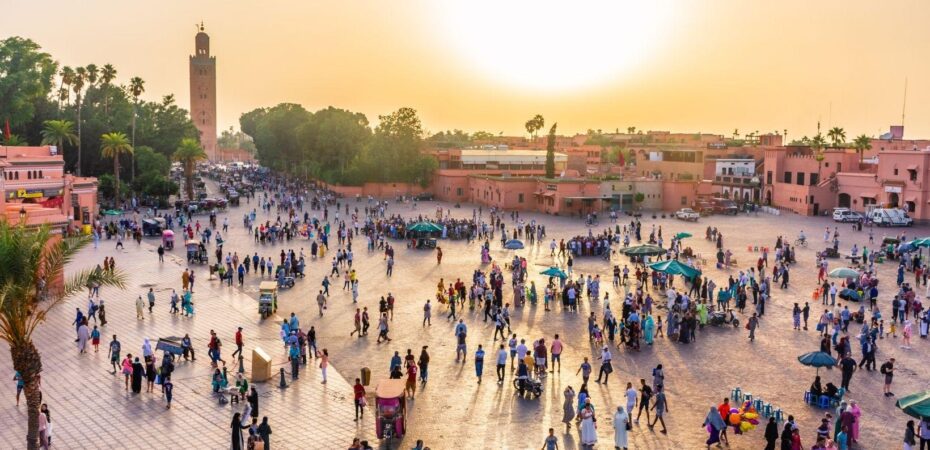
Marrakech is a city that rewards the senses. Known as the Red City for the ochre walls that ring its old town, it has drawn travellers for centuries with its labyrinth of souks, its palm groves and its position at the foot of the snow-capped High Atlas. For a first visit it can feel overwhelming, but with a little planning it quickly becomes one of the most rewarding destinations in North Africa. This guide covers what to see, where to eat and how to make the most of your trip.
The medina and Jemaa el-Fnaa
The heart of Marrakech is its medina, a UNESCO World Heritage site of narrow lanes, hidden courtyards and centuries-old architecture. At its centre lies Jemaa el-Fnaa, the great square that comes alive each evening with food stalls, musicians, storytellers and juice sellers. By day it is a busy crossroads; by night it becomes an open-air theatre. Grab a seat on a rooftop terrace overlooking the square at sunset, when the call to prayer echoes from the nearby Koutoubia Mosque and the smoke from the grills begins to rise.
Getting lost in the souks
Radiating out from Jemaa el-Fnaa are the souks, a maze of covered markets grouped loosely by trade. You will find lanterns, leather babouches, carpets, spices, ceramics and argan oil, often made in the same workshops where they are sold. Haggling is expected and part of the fun, so take your time, stay good-humoured and never feel pressured to buy. Getting lost is inevitable and half the pleasure; when you need to reorient, simply ask for Jemaa el-Fnaa and follow the flow of people.
Palaces, gardens and museums
Beyond the markets, Marrakech has a wealth of historic sights. The Bahia Palace is a nineteenth-century masterpiece of painted ceilings and tranquil courtyards, while the ruins of the El Badi Palace hint at the city’s former grandeur. The Saadian Tombs, rediscovered in 1917, hold some of the finest craftsmanship in the city. For a change of pace, the Majorelle Garden, once owned by Yves Saint Laurent, offers cobalt-blue buildings and a shaded oasis of bamboo and cacti. The nearby Yves Saint Laurent Museum is worth an hour of anyone’s time.
Where to stay
The classic choice is a riad, a traditional courtyard house tucked inside the medina. Staying in a riad places you within walking distance of the main sights and gives you a peaceful retreat from the bustle outside, usually with a plunge pool and a rooftop for breakfast. If you prefer modern hotels, spas and wider streets, the Gueliz and Hivernage districts offer contemporary comfort a short taxi ride from the old town. Families and larger groups often choose a private villa in the Palmeraie for space and a garden.
Eating in Marrakech
Moroccan cuisine is one of the great pleasures of a visit. Tagines of lamb with prunes, chicken with preserved lemon and olives, and hearty harira soup are staples, while pastilla, a sweet-and-savoury pie, is a speciality worth seeking out. Street food on Jemaa el-Fnaa ranges from grilled meats to snail soup for the adventurous. For something calmer, the city’s riad restaurants and rooftop terraces serve traditional dishes in beautiful settings. Mint tea, poured from a height, follows almost every meal.
Day trips beyond the city
Marrakech is the launch point for some of Morocco’s most memorable excursions. The High Atlas Mountains are less than two hours away, with Berber villages, waterfalls and the Toubkal massif within reach. The Agafay Desert offers a taste of the Sahara without the long drive, with rocky dunes, camel rides and camps under the stars. To the west, the breezy coastal town of Essaouira makes an easy day trip, while the Ourika Valley is a favourite for its greenery and riverside cafes. Guided trips take the stress out of transport and let you focus on the scenery, and you can book guided experiences in Marrakech with MaJourneys, which arranges the driver, guide and stops and confirms everything with the local provider before you set off, with payment made on the day rather than online.
Getting around
Within the medina, walking is the only real option, as most lanes are too narrow for cars. It is easy to lose your way, so an offline map helps. For longer trips across the city, petit taxis are cheap and plentiful; agree on the meter or a fare before you set off. Many riads will arrange a driver to meet you at the airport, which is well worth it on arrival when the medina’s lanes can feel bewildering with luggage in tow.
Practical tips
Dress modestly, especially in the medina and at religious sites, with shoulders and knees covered. Carry small cash for the souks, taxis and tips, as many small vendors do not take cards. Tap water is best avoided in favour of bottled water. Learn a few words of Arabic or French, both of which are widely spoken and always appreciated. Be firm but polite with the unofficial guides who may offer to show you the way, and keep an eye on your belongings in crowded areas as you would in any busy city.
When to visit
Spring, from March to May, and autumn, from September to November, offer the most comfortable weather, with warm days and cool evenings. Summer can be very hot, with temperatures regularly above forty degrees, though the desert and mountains provide relief. Winter is mild and quieter, with the added drama of snow on the Atlas peaks as a backdrop to the city. Whenever you go, start your days early to enjoy the softer light and the calmer streets before the crowds arrive.
Final thoughts
Marrakech is a city best approached with an open mind and an unhurried pace. Spend a morning in the souks, an afternoon by a riad pool, an evening on a rooftop above Jemaa el-Fnaa, and a day out in the mountains or the desert, and you will leave with a sense of a place that has enchanted travellers for generations. Plan a little, wander a lot, and let the Red City reveal itself at its own rhythm.
 By
By 


