
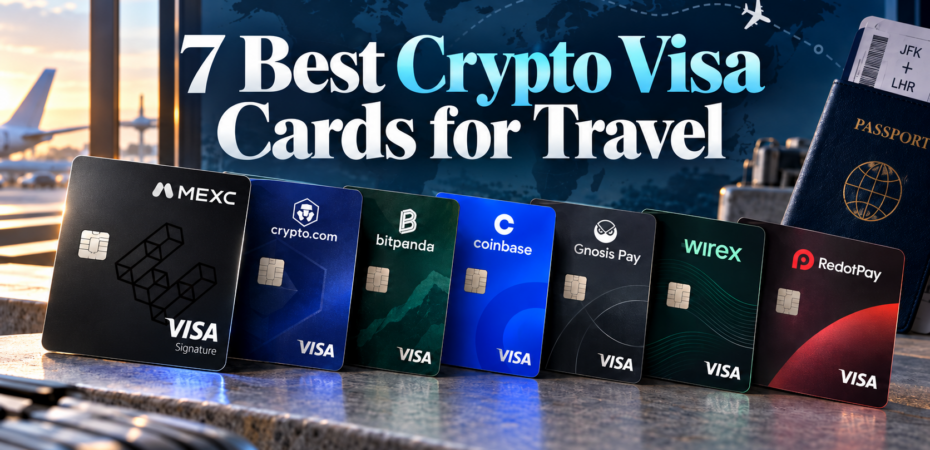
Crypto Visa cards let travelers spend crypto or stablecoin balances through ordinary Visa payments. The real question is what each card costs after transaction fees, conversion, FX treatment, ATM charges and reward requirements.
What Are the Best Crypto Visa Cards for Travel?
- MEXC Card: Best overall for phone-first international crypto spending
- Crypto.com Visa Card: Best for airport-lounge and premium travel benefits
- Bitpanda Card: Best for European travelers with broad asset support
- Coinbase Card: Best for existing Coinbase users
- WhiteBIT Nova: Best for travelers in Europe wanting physical and virtual cards
- Wirex Card: Best for multicurrency users where the local card is Visa
- RedotPay Card: Best for broad availability outside the U.S.
Eligibility can matter more than rank because issuance is region-specific.
Crypto Visa Cards Compared: Fees, Rewards and Travel Features
|
Rank |
Card |
Standard Purchase Cost |
Foreign Spending |
Rewards |
Physical / ATM |
Main Limitation |
|
#1 |
1% |
Visa rate; no MEXC FX markup |
4%–10% USDT, capped |
No / No |
Virtual-only |
|
|
#2 |
Tier/region dependent |
Tier and region dependent |
Level Up rewards |
Yes / Yes |
Best perks require higher plans |
|
|
#3 |
Trading/conversion cost may apply |
€0 Bitpanda FX fee; Visa markup may apply |
1% on eligible crypto spend |
Yes / Yes |
Europe-focused |
|
|
#4 |
No card transaction fee; crypto spread may apply |
Region-specific |
Variable |
Yes / Yes |
Mobile-wallet support varies |
|
|
#5 |
Up to 1% |
EUR-based card |
Category cashback, capped |
Yes / Yes |
Limited issuance region |
|
|
#6 |
Plan/product dependent |
No Wirex FX fee advertised |
0.5%–8% WXT by plan |
Yes / Yes |
Visa or Mastercard by region |
|
|
#7 |
1% crypto conversion |
1.2% cross-currency fee |
Limited |
Yes / Yes |
High issuance/ATM costs |
The table uses recurring terms. MEXC’s 0% purchase-fee promotion ends September 30, 2026; the normal Global Card fee is 1% from October 1 under the current schedule. The promotion is not used to justify its ranking.
How We Ranked the Best Crypto Visa Cards for Travelers
We prioritized recurring foreign-purchase costs, then geographic eligibility, ATM access, mobile-wallet support, rewards, supported assets, security and usability. Where a platform converts crypto to fund a purchase, conversion pricing or spreads are treated as part of the real spending cost.
MEXC remains #1 because its post-promotion cost is easy to model: a 1% purchase fee, no separate crypto-conversion fee and no MEXC markup on Visa’s rate, plus Apple Pay/Google Pay and USDT rewards. Because this ranking gives more weight to merchant purchases than cash withdrawals, those advantages offset its virtual-only format. Its lack of ATM access still counts against it; cash-heavy travelers should prefer a physical card.
7 Best Crypto Visa Cards for Travel in 2026
1. MEXC Card — Best Overall for Phone-First International Spending
MEXC Card is a virtual Visa Platinum funded with USDT. Its normal purchase fee is 1%, its listed crypto-conversion fee is 0%, and MEXC adds no markup to Visa’s exchange rate. It supports Apple Pay and Google Pay. Cashback is 4%, 6% or 10% in USDT by M-Score/VVIP tier, capped at 100, 300 or 800 USDT monthly.
Strength: transparent foreign-purchase pricing plus mobile-wallet support and stablecoin-denominated rewards.
Limitation: virtual-only, with no conventional ATM withdrawals; higher reward tiers require a higher M-Score.
2. Crypto.com Visa Card — Best for Travel Perks
Crypto.com’s physical Visa remains the travel-perk specialist, but lounge terms changed in 2026. Under the new Priority Pass rules, Pro users receive two complimentary visits per calendar year; Private users keep unlimited personal visits but lose free guest access. These changes took effect September 1 in most markets and take effect October 1 in the EU, UK and LATAM.
FX fees and allowances also vary by tier and region. In Europe, for example, Ruby and Jade/Indigo receive limited monthly non-EU/UK FX allowances from October 1 before a 2% fee applies, while higher tiers retain broader exemptions.
Strength: physical card, ATM access and meaningful lounge benefits.
Limitation: the best perks require higher Level Up plans, and fee rules vary significantly by market.
3. Bitpanda Card — Best for European Travelers With Diverse Holdings
Bitpanda’s Visa debit card supports 600+ crypto assets as payment sources, with transactions processed in EUR. Bitpanda lists a €0 non-EUR FX fee, but Visa markup or conversion fees can still apply. When crypto funds a payment, the asset is sold into EUR and the applicable Bitpanda trading cost also matters.
Its 1% cashback applies to qualifying crypto-funded purchases, not fiat, stablecoins, metals or Bitpanda Stocks.
Strength: broad asset support, physical card, ATM access and Apple Pay.
Limitation: ATM withdrawals cost 2% or at least €2, and issuance is mainly European.
4. Coinbase Card — Best for Existing Coinbase Users
Coinbase says card spending carries no Coinbase transaction fee, but a spread can apply when crypto is bought, sold or converted. It therefore fits existing Coinbase users better than travelers chasing maximum rewards.
Regional differences are important: the UK/EU Visa card does not currently support Apple Pay or Google Pay, while U.S. users do have mobile-wallet support.
Strength: simple integration with Coinbase balances and physical-card access.
Limitation: conversion spread and region-specific features can materially change the real travel cost.
5. WhiteBIT Nova — Best for Physical and Virtual Flexibility in Europe
WhiteBIT Nova is a Visa debit card available across much of the EEA and Ukraine. It offers physical and virtual cards, Apple Pay/Google Pay, and spending from selected WhiteBIT crypto balances after conversion to EUR. There is no monthly fee; transaction fees are listed as up to 1%.
Strength: both card formats plus mobile wallets and physical-card ATM access.
Limitation: ATM withdrawals cost €3 in the EEA and €3 plus 2.2% outside it; category cashback is capped at €25 monthly and changes dynamically.
6. Wirex Card — Best for Multicurrency Travelers
Wirex combines fiat, stablecoin and crypto balances and offers virtual and physical cards. It advertises no Wirex foreign-exchange fee, and ATM withdrawals are free up to a regional monthly allowance before a 2% charge. Cryptoback ranges from 0.5% on Standard to as much as 8% on Elite.
Strength: practical multicurrency structure and ATM support.
Limitation: Wirex issues Visa or Mastercard depending on region, so travelers specifically seeking Visa must check their local network; the maximum reward rate also requires a higher plan.
7. RedotPay Card — Best for Broad Availability Outside the U.S.
RedotPay offers virtual and physical cards under Visa programmes with Apple Pay and Google Pay. New cards are USD-settled, with a 1% crypto-conversion fee and 1.2% cross-currency fee.
Strength: broad international availability and both card formats.
Limitation: the virtual card costs $10, the physical card $100, and USD-card ATM withdrawals cost 2% up to $10,000 monthly and 3% above that. The U.S. and several other markets are excluded.
Read more: Best Apps to Help You Document Your Travels
What Can Make a Crypto Visa Card Expensive While Traveling?
Crypto conversion: A zero-fee card may still sell crypto at a spread or charge a trading fee. Stablecoin funding does not guarantee zero conversion cost.
FX and DCC: An issuer’s FX markup and Visa’s conversion rate are separate. “No issuer FX fee” does not mean the rate equals the mid-market rate. When offered dynamic currency conversion at a terminal or ATM, paying in the local currency generally avoids the merchant’s DCC markup.
ATM fees: Combine the card provider’s withdrawal charge with any surcharge from the ATM owner.
Reward-tier opportunity cost: High cashback may require token holdings, subscriptions or locked capital. Compare that cost with expected rewards.
Frequently Asked Questions About Crypto Visa Cards for Travel
Can I use a crypto Visa card in another country?
Usually, wherever that Visa product is accepted, subject to issuer restrictions, sanctions rules and blocked merchant categories.
Do merchants need to accept cryptocurrency?
No. The card provider handles conversion and the merchant receives a conventional card payment.
Which crypto Visa card has the lowest foreign transaction fees?
There is no permanent winner. Compare the card fee, crypto conversion or spread, issuer FX markup and Visa conversion together.
Are crypto card purchases taxable?
Potentially. Spending appreciated crypto can be treated as a disposal in some jurisdictions; local rules vary.
Can I use a crypto Visa card for hotels and car rentals?
Often, but preauthorization deposits and merchant restrictions can cause declines. Keep extra available balance for hotel holds and confirm rental-car acceptance before relying on one card.
 By Amey Myers


