

One guy in Chiang Mai spent five months building an affiliate site. In that time, he made $127 in total. It will take about 200 hours of work. That’s 63 cents for every hour you work. He almost quit. He didn’t give up, and now those same pages make between $1,200 and $1,800 every month. But people often leave out the part about the five months of $127.
Most guides about digital nomad income don’t talk about this at all.
What Are the Best Online Income Ideas for Digital Nomads?
|
Income Stream |
Time to First Real Money |
Realistic Monthly Range |
Internet Needed? |
|
Freelancing (writing, design, SEO, dev) |
1–4 weeks |
$1,500–$8,000 |
Yes |
|
Local lead generation |
2–6 months |
$500–$5,000 passive |
Medium |
|
Online courses and coaching |
3–12 months |
$200–$14,000 |
For live sessions |
|
Digital product sales |
1–6 months |
$100–$3,000 |
Low after setup |
|
Affiliate content websites |
6–24 months |
$0–$10,000+ |
Low after setup |
|
Remote employment |
Weeks if already hired |
$3,000–$12,000 |
Yes |
The difference between the top and bottom of the table is very big. Freelancing can pay within weeks. An affiliate site might not pay you for the first year. The most common reason people quit their jobs early is picking the wrong one for their current situation. This could be because they don’t have enough savings, the right skills, or the wrong city. When you are just starting out, the speed column is more important than the ceiling column.
How Do Digital Nomads Actually Make Money While Travelling?
According to Nomad List, the average monthly income for digital nomads in 2025 is around $4,800. The typical yearly salary is around $85,000. Those numbers look good. What they don’t tell you is that 69% of nomads earn between $50,000 and $250,000 a year, and the people at the top end of the scale make the average go up a lot. Many people at the bottom of that range are now in month three and wondering if this was a mistake.
The most common way to start freelancing is because you get paid fastest. A writer with ten years of experience can charge between $80 and $150 an hour from day one. If you are just starting out, you might get $15. The difference in cost of living is important because the cost of renting in Lisbon is not the same as in Chiang Mai. You need to earn enough money to match the cost of living in the city you are moving to, otherwise you will quickly use up your savings.
SolidGigs says that the most reliable ways to start are content writing, copywriting and design. If you’re a good writer, you can earn between $50 and $200 an hour once you’ve got a few clients. The hard part is getting your first clients. Most people spend more time looking for work than doing it in the first two months.
Those who last more than a year usually have more than one way of making money. A remote contract that pays the rent, something growing in the background like an affiliate site or a small course, and maybe one consulting client on the side. There are three things, not one. Some freelancers simply want a way to unwind after long stretches of client work — and occasionally look at lighter topics such as online slots South Africa just to switch off for a while.
What Is Local Lead Generation and Why Do Nomads Use It?
Local lead generation is not as fancy as it sounds. You build a simple website around a search like “plumber in Austin” or “wedding photographer in Brisbane,” get it to rank in Google, and then charge the local business a flat fee every month to send them the calls. You are not doing the plumbing. You are just owning the page that brings the customers.
Once the site ranks, it runs on its own. You can be in Bali. You can be on a bus. The site keeps working. Someone who has built fifteen of those sites over three years and gets half of them paying properly can pull in $3,000 to $5,000 a month with almost no daily effort. But it takes months to build each one before it earns anything at all.
The numbers on who actually makes it long-term are less flattering than most guides admit. Over half of nomads juggle multiple income streams because one is rarely enough. A meaningful share go home within the first year — not because they lacked skills, but because they ran out of runway before the income stabilised.
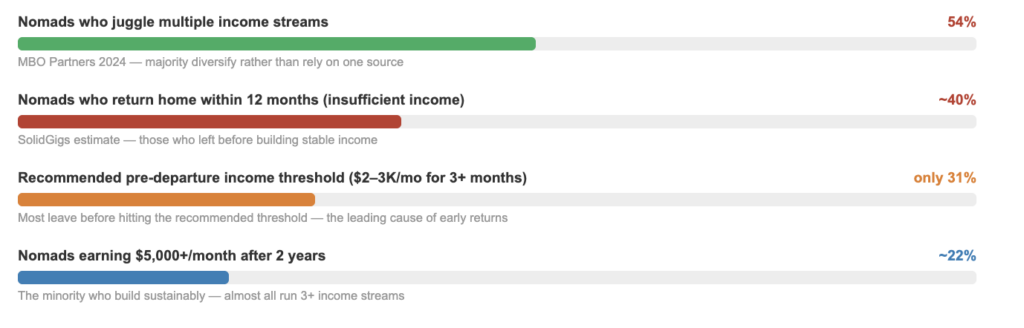
The Uncomfortable Numbers: Who Actually Makes It
Do Digital Products Actually Work as Passive Income?
They can. The honest version is that most do not, at least not fast. A resume template on Etsy might sell 200 times in its first year or it might sell twice. Nobody knows in advance. What makes digital products worth building is that after the initial work, the cost of selling one more copy is zero. You build it once and sell it as many times as it finds buyers.
The ones that work best are built around a very specific problem. Not “a guide to freelancing” but “a guide to getting your first three clients as a UX designer in 30 days.” The tighter the focus, the better it sells. That is the part most guides skip.
One rule we kept seeing repeated by nomads who have been doing this for more than two years: do not leave your job until you are making $2,000 to $3,000 a month consistently for at least three months. Not once. Consistently. The people who leave before that hit that threshold are the ones booking flights home six months later.
What separates the nomads who stay from the ones who go home:
- They built income before leaving, not after landing somewhere new
- They started in a cheap city and moved to an expensive one as earnings grew
- They used contracts for every piece of freelance work, every time
- They kept at least three months of savings untouched at all times
- They had two or three income sources before the end of year one
The $127 guy is now in Lisbon. He did not start there.
 By
By 


