

A canceled connection, a long gap between trains, an early night in a quiet resort town: downtime is the one thing almost every trip guarantees. You can only reread the same guidebook so many times, and the hotel bar closes eventually. For a lot of travelers, the phone becomes the entertainment center, and casino-style games have quietly become part of that mix.
There is an important catch, though. The versions many US travelers play are not real-money apps at all. They are free-to-play social casinos, and Bonus.com keeps a plain-language guide to social sweepstakes gaming platforms that lays out how the format works and where it is allowed. Reading something like it before you leave saves confusion at 30,000 feet, because these sites follow rules that have almost nothing to do with the gambling apps you might use at home.
This guide is about keeping that kind of play simple and legal while you move around. Not chasing winnings, not stretching a holiday budget, just understanding what actually travels with you and what gets left at the state line. The short version: the free-to-play model is designed to work almost anywhere in the US, but a handful of states have started to close the door, and 2026 has been the busiest year yet for those changes.
Why Downtime on the Road Changed What Travelers Play
Travel used to mean disconnecting. Now it usually means the opposite. Airport wifi, in-flight data, and generous roaming plans have turned the dead hours of a trip into screen time, and people fill that time with whatever is easy to start and easy to stop. Mobile puzzle games and streaming still dominate, but casino-style games have found a spot in the rotation because a single spin fits neatly into a five-minute wait.
What changed is not the games themselves. Slots, video poker, and table-game simulators have existed online for years. What changed is the payment model. A growing share of players never put money on the table at all. They use free-to-play formats that hand out virtual coins, which removes the part of gambling that makes people nervous on a shared hotel network or a work trip: the spending.
For travelers, the appeal is practical. There is no deposit to fund from a foreign ATM, no currency conversion, and no worrying about whether a transaction will trip a fraud alert on a card you are using two time zones from home. You open the app, you play with the coins you already have, and you close it when your row is called. That low-stakes, low-friction quality is a big reason the format keeps showing up in the hands of people who would never sign up for a real-money casino.
How the Free-to-Play Model Actually Works

Image by Greta Gallagher
The mechanics look strange until you see the logic underneath. Most social casinos run on two separate virtual currencies. The first is usually called Gold Coins, and it has no cash value at all. You use it to play for fun, and you can buy more of it if you want, the same way you would buy extra lives in a phone game. The second currency goes by names like Sweeps Coins, and it is the one that can be redeemed for prizes, including cash, once you meet the site’s play-through terms.
Here is the part that matters legally. You never have to buy the second currency. Sites hand it out through daily login bonuses, promotions, social media giveaways, and, by law, a free mail-in request. That free path is the whole point. American sweepstakes law treats an activity as gambling only when three things are present at once: consideration (paying to enter), chance, and a prize. Take away the requirement to pay, and the activity falls outside most gambling statutes. The dual-currency setup is built to remove that one element while keeping the games that people actually want to play.
For a traveler, the takeaway is simple. You are not funding an account, and you are not required to spend anything to keep going. The coins refill through everyday promotions, which is why the format can survive a long trip without a single transaction.
Free-to-Play vs Real-Money Casinos: The Difference That Matters on a Trip
It is easy to blur these two together, and plenty of travelers do. The distinction matters far more when you are moving around than when you are sitting at home.
Real-money online casinos are the licensed operations where you deposit funds and wager them directly. In the US, they are legal in only a small number of states, and they check your location every time you play. Cross into a state that has not legalized them and the app simply stops working. That is fine when you know your home state qualifies, but it makes real-money play unreliable the moment you leave.
Free-to-play social casinos work across a wider footprint because they are not classed as gambling in most places. That is what makes them attractive to someone who is constantly changing zip codes. The trade-off is that prize redemption, not gameplay, is where the rules bite, and a growing group of states now restrict the model outright.
So the mental model is this: real-money play is narrow but direct, and free-to-play is broad but indirect. Travelers who understand which one they are using rarely get caught out. The confusion usually comes from assuming a free-to-play app follows the same map as a betting app, when the two are drawn very differently.
Packing a Setup That Keeps You Connected
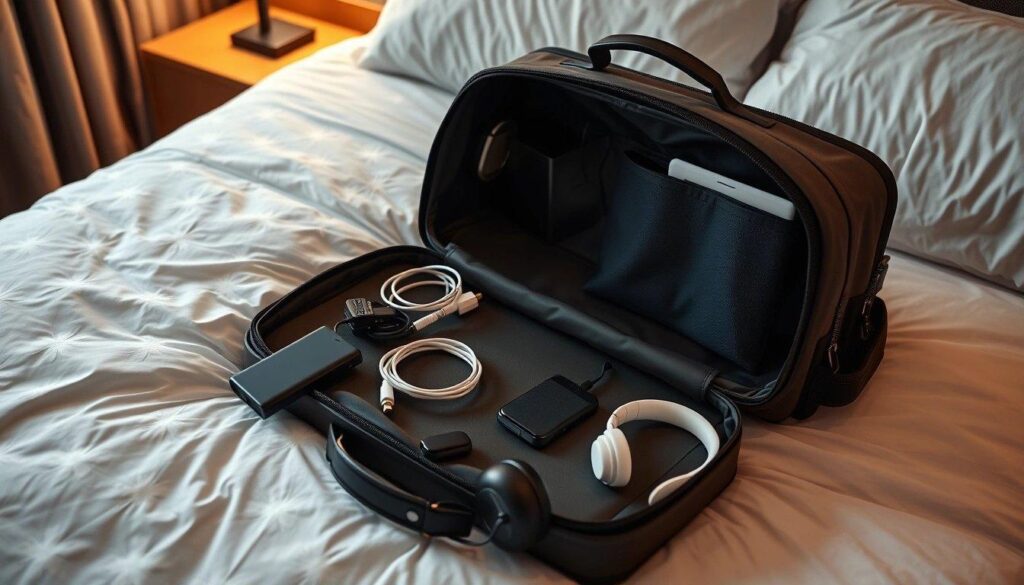
Image by Greta Gallagher
None of this works without a stable connection, and that is where a little planning pays off. Free-to-play sites are not data-hungry the way video streaming is, but they do need a steady signal to load games and confirm your location. A dropped connection mid-session is annoying at best and, on the redemption side, can leave a prize claim stuck in limbo.
A few habits keep things smooth. Download the apps you plan to use before you leave, while you are still on trusted home wifi, rather than over a crowded airport hotspot. Carry a power bank, because location checks and app refreshes nibble at battery faster than you expect. And treat public wifi with the same caution you would give any account that touches money or personal details.
The same thinking that saves you stress at check-in applies here. If you have ever used these easy hotel booking hacks to lock in a better room and a smoother arrival, apply the same prep to your devices: sort out connectivity and charging before you need them, not after. A ten-minute setup at home beats troubleshooting from a lobby with one bar of signal.
One more caution. Do not reach for a VPN to fake your location. It almost always breaks a site’s terms of service, and it can void any prize you were hoping to redeem. The whole model depends on honest geolocation, and spoofing it is the fastest way to lose access for good.
What Geolocation Decides the Moment You Land
Every serious free-to-play platform uses geolocation, the same technology betting apps rely on. When you open the app, it checks where you are and compares that against the states where the operator allows play and, separately, redemption. In most of the country, nothing happens and you carry on. In a restricted state, you may find that redemption is switched off, or that the app will not run at all.
This is the single biggest thing that changes for a traveler. At home, your location is fixed and you never think about it. On the road, your location is the variable, and it can flip from allowed to restricted in the time it takes to cross a bridge. A player who lives in a permitted state and drives into a restricted one can lose access mid-trip without doing anything wrong.
Crossing an international border is even easier to predict. US social casinos are built for US players, and most block access entirely once you are outside the country. If you are flying to Europe or Asia, assume the apps will go dark on landing and plan your entertainment around that. The free coins will still be waiting when you get home.
Crossing State Lines: Where Sweepstakes Play Is Restricted
The list of states that restrict the dual-currency model is short but growing, and 2026 has been the year it grew fastest. The table below is a snapshot for travelers, not legal advice, and because the rules keep shifting you should confirm the current status before you rely on it. Availability and effective dates can change with little notice.
|
State |
Status for free-to-play sweeps |
What a traveler should note |
|
California |
Dual-currency model banned as of Jan 1, 2026 |
Major operators pulled out in late 2025; expect apps to go dark |
|
New York |
Restricted under a 2025 law |
Redemption and access limited; verify before you play |
|
Connecticut |
Long restricted |
A tight stance on the model predates the 2025 wave |
|
Montana |
Restricted in 2025 |
Smaller market, but the limits are real |
|
Indiana |
Ban effective July 1, 2026 |
New for mid-2026 travelers to watch |
|
Maine |
Restrictions expected mid-2026 |
Check the latest before a summer trip |
Most other states still permit the format as of mid-2026, which is why it remains a reasonable travel companion for people whose trips avoid the restricted list. Still, the direction of change is toward more limits, not fewer, so a route that was clear last year is worth rechecking this year.
California’s Ban and What It Signals
California deserves its own note, because it is the clearest sign of where things are heading. In October 2025, the governor signed Assembly Bill 831, and the ban took effect on January 1, 2026. It passed without a single no vote in either chamber, which almost never happens with gambling legislation, and it did more than target operators. The law reaches vendors and partners too, including payment processors and marketing affiliates that knowingly support the banned model.
For a traveler, the practical effect is blunt. If your trip runs through California, plan as though the dual-currency apps will not work there, because several major operators withdrew from the state rather than risk the penalties. This is not a gray area that a workaround solves.
If you want to see how the copycat wave reads, New York published the full text of its own sweepstakes ban, which spells out exactly what the dual-currency model means and what counts as a violation. It is dry reading, but it explains why operators reacted so quickly. The reason this matters beyond California is copycat momentum: when a large state writes a clean, unanimous ban, other legislatures tend to borrow the wording.
A Pre-Trip Checklist for Free-to-Play Gaming
Image by Greta Gallagher
A little prep keeps this in the background of a trip instead of a source of friction. Run through a short checklist before you go.
- Confirm your destinations. Check whether any state on your route restricts the model, and treat California, New York, Connecticut, and Montana as automatic red flags for 2026.
- Download in advance. Install and update apps on home wifi so you are not fighting a weak signal later.
- Pack power. A power bank covers the extra battery that location checks and refreshes use up.
- Know your free paths. Note how each site hands out its redeemable currency, whether that is daily bonuses, promotions, or a mail-in request, so you are not tempted to buy anything on the road.
- Set a time limit, not just a budget. With free-to-play, money is rarely the risk; time is. Decide in advance how much of your trip you actually want to spend on a screen.
- Skip the VPN. Spoofing your location risks your access and any prizes tied to it.
None of this takes more than a few minutes, and it turns a potentially confusing part of a trip into something you barely think about.
Staying in Control When Every Day Is Different
Routine is the quiet thing that keeps play healthy, and travel strips routine away. Your sleep is off, your meals are irregular, and long stretches of boredom show up at odd hours. That combination can turn a five-minute distraction into a two-hour one before you notice.
The fix is not complicated. Because free-to-play removes the money pressure, the main resource to protect on a trip is your time and attention. Set a rough cap on how long a session runs, and lean on the app’s own reminders if it has them. If you find yourself opening a game to avoid dealing with a delay or a bad day, that is a signal to put the phone down and do something else with the layover.
It also helps to keep the activity in its proper place. These games are a way to pass dead time, not a reason to skip the trip you paid for. The travelers who enjoy them most treat them like a paperback in a bag: handy when you are stuck, easy to set aside when something better comes along. If play ever stops feeling optional, most platforms offer self-exclusion and time-out tools, and every US region has free support lines worth saving in your phone before you leave.
Where the Rules Are Heading Next
The pattern for the next couple of years looks fairly set. More states will weigh restrictions, a few will pass them, and the map travelers rely on will keep shifting under their feet. The dual-currency model is not disappearing nationally, but its footprint is being trimmed at the edges by state legislatures, tribal gaming interests, and regulators who see it as too close to real gambling.
For anyone who plays while traveling, the honest advice is to hold the situation loosely. What is allowed on your spring trip may not be allowed on your fall one, and a state you passed through without a thought last year might restrict the model by the time you return. That is not a reason to avoid the format. It is a reason to check before you rely on it, the same way you would check a visa requirement or a baggage rule.
The good news is that the core promise holds. As long as you are in a permitted state, the free-to-play model still does what travelers want: it fills dead time without asking for a deposit, a conversion, or a commitment. Keep an eye on the states tightening the rules, keep your setup simple, and the rest takes care of itself.
Frequently Asked Questions
Can I keep playing a US sweepstakes app while I am abroad?
Usually not. These platforms are built for players inside the United States, and most block access once your location reads as outside the country. Your account and any free coins stay put, so you can pick up again when you return home.
Do I lose my coins if I travel into a restricted state?
Your balance generally stays in your account, but you may be unable to play or redeem while your location reads as a restricted state such as California or New York in 2026. Access typically returns once you are back in a permitted state, though you should confirm each site’s own policy.
Is it legal to use a VPN to keep playing where the app is blocked?
It is a bad idea. Using a VPN to disguise your location almost always breaks the site’s terms of service, and it can void any prize you were trying to redeem. The entire model depends on accurate geolocation, so spoofing it puts your account at risk.
How is this different from the betting apps I use at home?
Betting and real-money casino apps take deposits and are legal in only a few states, so they stop working the moment you cross into a state that has not legalized them. Free-to-play social casinos do not take wagers, run on virtual coins, and are permitted more widely, though a growing number of states restrict the redeemable side.
Do I really never have to spend money to play?
Correct. The redeemable currency is always available through free routes such as daily bonuses, promotions, or a mail-in request, which is the legal foundation of the whole model. Buying coins is optional and adds nothing you cannot eventually get for free, which is a big reason the format travels so well.
 By Olivia Gril


