
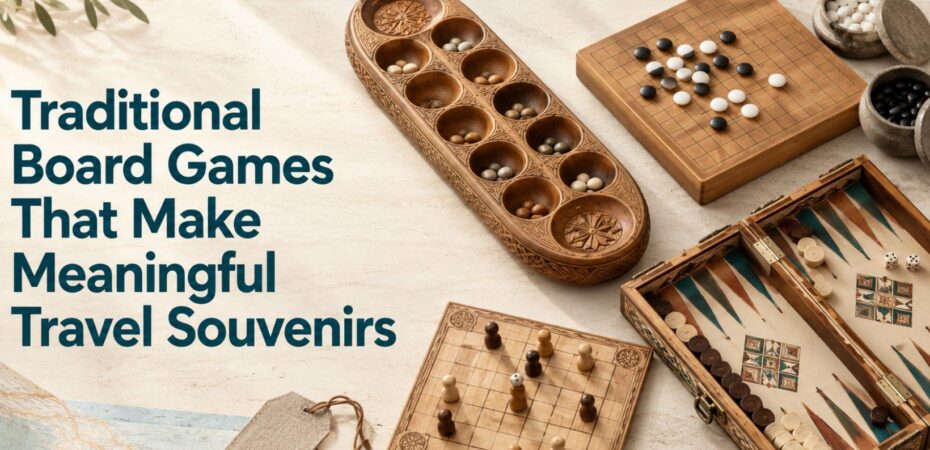
The most memorable travel souvenirs often have a life beyond the journey. A locally made board game can be displayed at home, brought to the table with friends and used to recall the people and places encountered abroad. Before purchasing an unfamiliar game, you can visit gamerules.com to learn its basic rules and understand whether it will suit the people with whom you normally play. From carved mancala boards to compact backgammon sets, traditional games combine craftsmanship, social history and entertainment in an object that can remain meaningful for years.
Unlike a mass-produced magnet or souvenir T-shirt, a regional game can reveal how a community spends time, teaches strategy and brings different generations together. Its board may also preserve local woodworking, stone carving, textile or decorative traditions.
However, buying traditional board games around the world requires a little preparation. Travellers should understand that familiar names may refer to several regional variants, that decorative sets are not always suitable for play and that an object marketed as “ancient” is not necessarily locally made.
The following games provide a useful starting point for travellers looking for cultural travel souvenirs with a genuine connection to their destination.
Mancala: a family of games rather than a single rulebook
Mancala is sometimes presented as one ancient game with a universally accepted set of rules. In reality, it is a broad family of “count and capture” games played in numerous parts of Africa, the Middle East, Asia and the Caribbean.
The basic mechanism normally involves picking up counters from one hole and distributing—or “sowing”—them individually into subsequent holes. What happens when the final counter lands, how pieces are captured and how the winner is determined can differ considerably between regions.
The British Museum’s description of a Sierra Leonean mancala board explains that the term covers games with many local names and rules. The museum identifies ayo in Nigeria and wari across West Africa and the Caribbean as two well-known examples. Other travellers may encounter names such as oware, bao, omweso or congkak, each with its own traditions and methods of play.
This variety is precisely what makes mancala such an interesting travel souvenir. A set purchased in Ghana may represent a different playing culture from one found in Kenya, Zanzibar, Malaysia or Jordan.
What an authentic mancala set looks like
There is no single correct material. Mancala has historically been played with whatever was readily available: seeds, shells, stones or small pieces of wood. Holes can be carved into a wooden board, scooped directly into the ground or cut into stone.
A handcrafted wooden set can be a particularly attractive souvenir. Look for slightly irregular carving, visible wood grain and evidence that the pits have been finished by hand. Local decorative patterns can add cultural significance, but the pits should still be deep and smooth enough to hold the required counters.
Ask the seller for the local name of the game and, if possible, for a demonstration. This does more than confirm that the set is playable. It also provides a story and a specific rule set to bring home.
Avoid assuming that every folding board with six pits on each side represents the local tradition. Some are made specifically for visitors and include rules imported from commercial Western editions. Such a set may still be enjoyable, but it is better to understand what you are buying.
Go in China, Korea and Japan
Go is among the oldest continuously played strategy games in the world. It originated in China, where it is known as weiqi, and subsequently became deeply established in Korea as baduk and Japan as igo or simply Go.
Two players place black and white stones on the intersections of a grid, attempting to surround territory and capture opposing stones. The rules are concise, yet the number of possible positions gives the game extraordinary strategic depth.
According to the British Go Association’s historical overview, the game almost certainly originated in China around 3,000–4,000 years ago. It later flourished in Japan, where professional schools and ranking systems contributed substantially to its development. China, Korea, Japan and Taiwan all maintain strong playing traditions today.
This shared history makes a Go set an appealing purchase across East Asia, but regional names and styles should not be treated as interchangeable decoration. A set bought in Seoul can represent Korea’s active baduk culture, while one purchased in Japan may reflect distinctive preferences in board construction and stone shape.
Choosing a Go set as a travel souvenir
A standard full-sized board contains a 19-by-19 grid. Smaller 9-by-9 and 13-by-13 boards are commonly used for learning, short games and portable sets. Travellers with limited luggage space may find one of these smaller boards more practical.
Traditional Japanese floor boards can be impressively thick and may include short legs. High-quality examples are beautiful objects but are heavy, expensive and difficult to transport. A tabletop board offers a better balance between authenticity and practicality for most visitors.
Go stones also vary in quality. Affordable sets may use glass or plastic, while premium Japanese sets can feature slate and shell. Shell stones should be purchased from reputable businesses able to explain their origin and grading. Travellers who prefer to avoid animal-derived materials can choose glass, ceramic or stone alternatives.
Check that the grid is clear, the board lies flat and the bowls close securely. If the set is intended for regular use, playing comfort matters more than an elaborate presentation box.
Specialist Go shops, cultural centres and established game retailers are usually more reliable than generic souvenir outlets. They are also more likely to explain the differences between beginner, portable and traditional equipment.
Backgammon around the eastern Mediterranean
Few games are as closely connected with cafés, homes and social gatherings as backgammon. Travellers may see related tables games played in Greece, Turkey, Cyprus, Lebanon and neighbouring countries.
The familiar board contains 24 narrow points, 15 pieces for each player and a pair of dice. Yet the cultural experience varies from place to place. In Greece, travellers may hear the word tavli, which commonly refers to a group of related games played on the same board. In Turkey, tavla is a familiar part of social life, with the rapid movement of pieces and sound of dice creating an instantly recognisable atmosphere.
Backgammon belongs to a long lineage of tables and race games shaped by centuries of cultural exchange. Its development should not be reduced to a single neat origin story. Related games travelled through Persia, the wider Islamic world, the Mediterranean and Europe, changing as they moved.
A backgammon set therefore works especially well as a travel souvenir when it reflects local workmanship rather than merely carrying the name of a destination.
How to identify a good backgammon set
Open and close a folding set several times before purchasing it. The hinges should move cleanly, and the two halves should meet without leaving a wide gap. Place it on a flat counter to check whether it rocks.
Inspect the playing surface closely. Painted points should have clean edges, while an inlaid wooden or mother-of-pearl-style board should have firmly attached pieces without sharp corners. Count the checkers and make sure the set includes dice. If there are dice cups, test whether they fit inside when the board is closed.
Wooden sets may be carved or decorated with marquetry, a technique that uses contrasting pieces of material to create patterns. Ask where the set was produced and what materials were used. A shopkeeper who can identify the workshop, region or craft technique is providing more useful information than one who simply describes every board as handmade.
Size matters too. A very small board is easy to pack but can be awkward to play because the pieces become crowded. A medium folding board is often the best compromise for a traveller who wants a usable souvenir rather than a purely decorative object.
Hnefatafl and the games of northern Europe
Visitors to Scandinavia may encounter hnefatafl, frequently marketed as the “Viking game” or “Viking chess”. It belongs to the wider tafl family of asymmetric strategy games played in northern Europe before chess became dominant.
Unlike chess, the two sides begin with different forces and objectives. One player controls a king and a smaller group of defenders positioned near the centre. The opponent controls a larger attacking force arranged around the outside. The king normally attempts to escape, while the attackers try to capture him.
Archaeological finds, historical references and later descriptions show that tafl games existed in several forms. However, their complete medieval rules did not survive in one definitive written source. Modern hnefatafl editions consequently use reconstructed rule systems, and these can differ in board size, escape conditions and methods of capturing the king.
That uncertainty does not make the game an unsuitable souvenir. On the contrary, it offers an opportunity to discuss how historians, archaeologists and modern players reconstruct past leisure activities. Buyers should simply avoid sets claiming to reproduce the only authentic Viking rules.
What to look for in a Scandinavian tafl set
Tafl sets are available in wood, stone, leather and textile formats. Boards may contain 7, 9, 11 or more squares on each side, depending on the variant.
For a culturally meaningful purchase, look for a maker who identifies the specific version represented and supplies a complete rulebook. Decorative runes and stylised Viking figures can be attractive, but they do not prove historical accuracy.
Museum shops, heritage centres and independent craftspeople are sensible places to begin. A museum reproduction should explain which archaeological object or historical period inspired its design. An artisan-made set should provide information about its materials and production.
Be cautious with bone, horn, antler or ivory-like pieces. Ask exactly what material has been used and whether it can legally be carried across borders. Wooden alternatives are simpler to transport and can still reflect Scandinavian carving traditions.
Why local games are better than generic souvenirs
A well-chosen board game can preserve several layers of a journey at once. The physical object recalls a marketplace, workshop or neighbourhood. The rules record a form of local knowledge, while future games allow the souvenir to become part of life at home.
Traditional games also encourage conversations that conventional souvenirs rarely produce. Teaching friends a regional mancala variant can lead to a discussion about where it was purchased and how local players introduced it. Opening a tavla board can recall an evening spent watching games in a Turkish café. A Go set may inspire further reading about East Asian history and strategy.
Most importantly, the souvenir remains active. It is handled, shared and interpreted instead of being placed permanently on a shelf.
Where to buy local board games abroad
The best place depends on the type of souvenir sought. Consider:
When buying directly from an artisan, ask how long the set took to produce, which materials were used and whether the design has a particular meaning. These questions demonstrate genuine interest and help distinguish local work from imported products.
Price alone cannot establish authenticity. A cheap set may be locally made from simple materials, while an expensive object may be a factory-produced item decorated for tourists. Information about the maker is usually more valuable than polished packaging.
Practical checks before putting a game in your luggage
Before completing the purchase, confirm that every component is present. Photograph the complete set and its contents, particularly if it contains numerous stones, counters or specialised pieces.
Keep the rules, the maker’s card and any certificate supplied with the item. Wrap boards carefully and store loose components in a cloth pouch or resealable bag. Heavy Go stones may be better placed in hand luggage only if they comply with the airline’s weight restrictions.
Travellers should also investigate customs rules for animal products, rare woods and antiques. An object being offered for sale does not automatically mean it can be legally exported or imported. When in doubt, choose contemporary pieces made from ordinary, clearly identified materials.
A souvenir that keeps telling its story
The best board game souvenirs connect an object to a specific place and living tradition. Mancala introduces travellers to a vast family of regional games rather than one universal format. Go reflects thousands of years of East Asian intellectual and social history. Backgammon evokes the sociable playing culture of the eastern Mediterranean, while hnefatafl opens a window onto the reconstructed games of medieval northern Europe.
Choosing carefully means looking beyond a decorative board. Learn the local name, ask for the regional rules, identify the materials and seek information about the maker. A modest handcrafted set with a clear story can be far more meaningful than an expensive but anonymous product.
Once brought home and taught to someone else, the game becomes more than a reminder of a trip. It becomes a repeatable experience: one that allows the culture, conversations and discoveries of the journey to return every time the pieces are placed on the board.
 By
By 


