
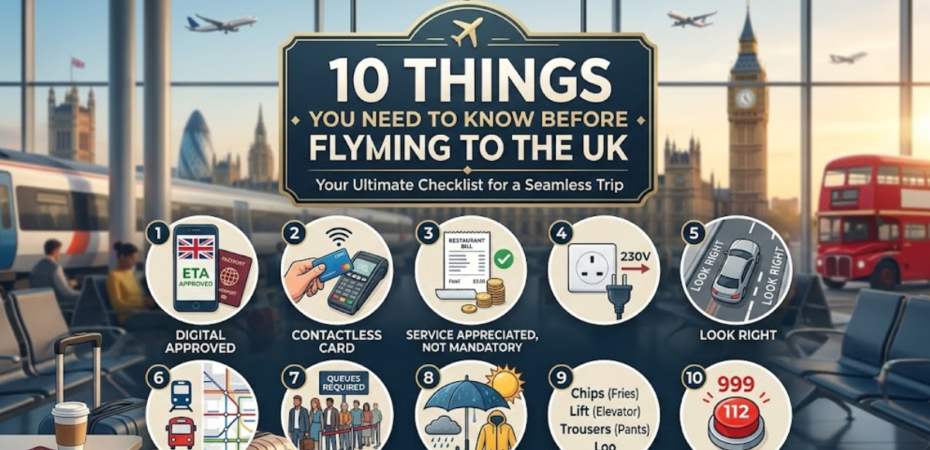
The UK is one of the most visited destinations in the world, attracting tens of millions of international travelers every year. Whether you are visiting London for the first time, exploring Scotland, or making your way through the English countryside, the experience of arriving in the UK is significantly smoother when you know what to expect before you board your flight. From border control to currency to cultural norms, here are ten things every traveler should know before flying to the UK in 2026.
1. Your Passport and Visa Requirements Have Changed Post-Brexit
Brexit has permanently changed the entry requirements for travelers arriving in the UK from EU countries and beyond. EU citizens no longer have automatic right of residence in the UK and are now subject to the same immigration controls as other international visitors. Depending on your nationality and the purpose of your visit, you may need a visa before you travel. It’s also important to note that a Schengen visa does not grant entry into the UK, as the country is not part of the Schengen Area, meaning travelers may need separate authorization depending on their itinerary.
UK visitors from many countries including the United States, Canada, and Australia can currently enter for short stays without a pre-arranged visa, but this is subject to change. Always check the UK Government’s official visa checker well in advance of your travel date rather than relying on information from third party travel sites that may not reflect the most current requirements.
2. The Electronic Travel Authorisation Is Now Required for Many Visitors
The UK introduced its Electronic Travel Authorisation scheme, known as the ETA, as part of its post-Brexit border modernization program. Many international visitors who previously did not need any pre-travel authorization now need to obtain an ETA before arriving in the UK, even for short tourist visits.
The ETA is not a visa but it is a mandatory travel permission that must be linked to your passport before you board your flight. Failing to obtain one where required may result in being denied boarding at your departure airport. Applications are made through the official UK government platform and processing times vary, so applying several weeks before travel is strongly advisable.
3. Know What You Can and Cannot Bring Through UK Customs
UK customs rules are strict and enforced seriously at all ports of entry. There are clear limits on the amount of alcohol, tobacco, and goods you can bring into the country without paying duty. Cash above a certain threshold must be declared. Certain food products, particularly meat and dairy from outside the EU, are restricted or prohibited entirely.
One area that catches international travelers off guard is CBD and hemp-derived products. While CBD oil is legal in the UK when it meets specific regulatory requirements, CBD hash and similar hemp-derived products occupy a more complex legal space that varies significantly depending on THC content and product classification. If you use CBD hash UK or any hemp products at home, research UK regulations specific to that product type thoroughly before packing them in your luggage.
4. The UK Uses Its Own Currency
The UK uses the pound sterling, not the euro. This catches a surprising number of first-time visitors off guard, particularly those traveling from EU countries where euro acceptance is widespread. Euros are not accepted in standard UK shops, restaurants, or transport systems.
Exchange currency before you travel or use a fee-free travel card that gives you access to competitive exchange rates without the airport markup. ATMs are widely available across the UK but check whether your home bank charges international withdrawal fees before relying on them as your primary cash source.
5. Border Control at UK Airports Takes Time
UK border control is thorough and can be time-consuming, particularly at busy airports like Heathrow, Gatwick, and Manchester during peak travel periods. Non-UK and non-Irish passport holders queue separately from British and Irish citizens, and that queue can be significantly longer during busy arrival windows.
Factor border control time into your onward travel plans. If you have a connecting train, a hotel check-in with a hard cutoff, or a pickup arranged for a specific time, build in more buffers than you think you need. Heathrow in particular is a large airport where transit between terminals and passport control can add significant time to your arrival process.
6. Public Transport Is Excellent but Requires Planning

The UK has one of the most extensive public transport networks in Europe, particularly in London and between major cities. The London Underground, national rail network, and extensive bus services make it entirely possible to travel the country without a car. However, navigating these systems efficiently requires some advance planning.
Rail tickets booked in advance are significantly cheaper than walk-up fares, sometimes by a substantial margin. The Oyster card or a contactless bank card is the most efficient way to travel within London’s transport zones. Outside London, regional transport apps and the National Rail website are the most reliable sources for timetables and booking.
7. The Weather Is Unpredictable Regardless of Season
The UK’s reputation for changeable weather is entirely earned. Rain is possible in any month, in any region, at any time of day. Packing a compact waterproof layer regardless of when you are visiting is not pessimism. It is practical preparation that most experienced UK visitors have learned the hard way.
Summer in the UK can be genuinely warm and sunny, but it can also be cool and overcast. Winter visits to Scotland in particular require proper cold weather preparation. Checking a reliable UK weather service in the days before you travel gives you a more accurate picture than any seasonal generalization.
8. Tipping Culture Is Different From the United States
If you are traveling from the United States, adjusting your expectations around tipping will make your UK experience more comfortable for everyone involved. Tipping in the UK is appreciated but not expected at the level American visitors are accustomed to. In restaurants, a tip of ten percent is considered generous. Many restaurants add a discretionary service charge to the bill automatically, in which case an additional tip is not expected.
Tipping taxi drivers, hotel porters, and hairdressers is common but again at a more modest level than American norms. Tipping at a pub bar is not standard practice in the UK, though offering to buy the bartender a drink is an accepted gesture in some contexts.
9. Healthcare Works Differently for Visitors
The UK’s National Health Service provides free healthcare to UK residents but visitors from outside the UK are generally required to pay for NHS treatment unless they come from a country with a reciprocal healthcare agreement. The UK has maintained some reciprocal agreements post-Brexit but coverage varies by country and circumstance.
Travel insurance that includes comprehensive medical coverage is strongly advisable for any international visitor to the UK. According to the NHS official website, visitors who require emergency treatment will be seen regardless of their insurance status, but non-emergency treatment may be subject to charges for overseas visitors without reciprocal agreement coverage.
10. Cultural Norms Are Worth Understanding Before You Arrive
The UK has a distinct set of social norms that are worth being aware of before you arrive. Queuing, which means waiting in an orderly line, is taken seriously across the UK and jumping a queue is considered genuinely rude rather than a minor social infraction. Holding doors open for people behind you is standard courtesy. Speaking at a moderate volume in public spaces, particularly on public transport, is the norm rather than the exception.
British understatement is a real cultural phenomenon. When a British person describes something as quite good or not bad, they may mean it is excellent. When someone says that is interesting, they may mean the opposite entirely. A basic awareness of this communication style helps international visitors navigate social interactions with more confidence and fewer misunderstandings.
The UK rewards travelers who arrive prepared. These ten points cover the practical and cultural foundations that make the difference between a stressful arrival and a smooth start to what is, for most visitors, a genuinely rewarding travel experience.
 By Gregory O'Neill
Greg is a modern-day explorer with an insatiable love for travel. His passion for adventure has led him to far-flung corners of the world, where he immerses himself in diverse cultures and experiences. Greg's zest for life is epitomized by a continuous pursuit of new horizons and captivating journeys.